
Nature’s Way Resources is proud to bring you this free weekly newsletter. While we don’t run ads, generous sponsors help support this project as a public service. Their names are listed below, please consider showing your appreciation by supporting their businesses!
Nature’s Way Resources honors the contributions of our late owner, John Ferguson. “The Lazy Gardener” Brenda Beust Smith and Shelby Cassano welcome your feedback and remain grateful to the many horticulturists who share their expertise.
Published September 30, 2026
Gardening with herbs… is indulged in by those who like subtlety in their plants in preference to brilliance.” — Helen Morgenthau Fox, American botanist and gardening author
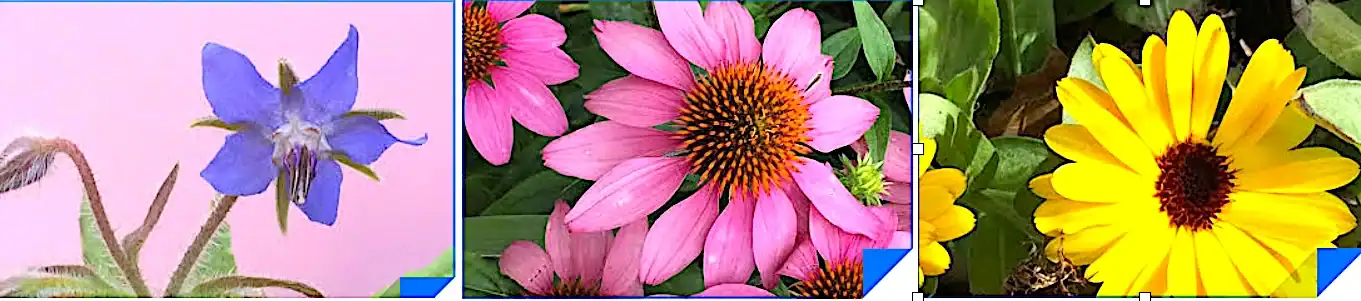
HERBAL GARDEN BEAUTIES: L to r: borage, purple coneflower, calendula. . . . time to start/enlarge an herbal garden! Spotlight Article below and all photos by Susan Gail Wood
by Brenda Beust Smith | The Lazy Gardener
Boy, has the weather ever suddenly changed for the better! (Watch it mysteriously jump back up into the the 100ºs just ’cause I wrote this!). But doesn’t it make you want to get out in the garden and pull weeds? Well, maybe not, but at least to look closer at all your plants?
We’re getting into serious herb planting time (often referred to as Houston’s Best Planting Season. Be sure to check the calendar below for our area’s great events like the big upcoming 53-year-old Annual Herb Fair, an annual gift from the The Herb Society of America, South Texas Unit on SAT. NOV. 7: 53rd ANNUAL HERB FAIR by THE HERB SOCIETY OF AMERICA, SOUTH TEXAS UNIT, 9am-2pm, Southside Place Clubhouse, 3743 Garnet St., Free. herbsociety-stu.org
In the meantime, you might be looking for good spots for new plants, especially new herb plantings. When you attend this Annual Herb Fair, or any other plant sale, have some site ideas in mind before you go. Pictures to show these to plant sale folks is an excellent idea. Below are more suggestions to add to notes you bring or share with sales helper — no matter what plant sales you’re attending — good for all
- The area exactly where you live! Big difference between (for example) Conroe and Galveston!
- Hours of actual sun site receives.
- Time of day taken. Makes a difference!
- Drainage situations (high area of yard, low area where water collects, etc.}
- Adjacent plantings. Not all plants are good neighbors, and some actually are allelopathic. — may not like each other — a situation when plants release natural chemicals that harm or stop the growth of neighboring plants; it is called allelopathy. Check out this Texas A&M link.
- Situations that might change in future, like newly planted large trees.
- Ask for eventual growth heights and widths of desired plants in your area. Important. Our climate is not exactly like those even in other areas of Texas. Some plants tend to get much bigger (or smaller) than shown in information.
- Be sure to write down what you’re told about new-to-you plants.
NOW . . . Did the flowers at the top really catch your eye? And then did your eyebrows rise when you read these are herbs?
IN OUR SPOTLIGHT ARTICLE below, SUSAN GAIL WOOD, this newsletter’s longtime go-to “growing Herbs in Houston” resource, takes a look at the doors opening for great herbal gardens! With herbs and the personal uses we associate with them, it’s vital that we do what works best in our particular climate. Best source around here: the upcoming 53-year-old Annual Herb Fair, an annual gift from the The Herb Society of America, South Texas Unit, on Saturday, Nov. 7, 2026, 9am– 2pm, (DETAILS: herbsociety-stu.org/annual-herb-fair/). Below, Susan offers tips — to get you in the mood! — on common mistakes even experienced herb growers sometimes make!
* * *


MISTAKES TO AVOID
WHEN GROWING HERBS!
By SUSAN GAIL WOOD
Award winning Lifetime Member of The Herb Society of America
- Don’t try to garden the way they do “up north”. The Houston area is zone 9B; plant accordingly.
- Don’t try to grow basil before the soil warms up. It needs warm days to germinate from seed. Plants can be set out in late spring or early summer since they love the heat.
- Don’t try to grow cool-weather annual herbs in the summer. Plant dill, parsley, fennel, borage, cilantro, coriander, calendula, and nasturtiums in late fall. (Nasturtiums will die back from a hard freeze.) All will go to seed once the weather heats up when it is time to plant basil.
- Don’t cut back or remove annual herbs before seed ripens, eliminating “volunteers” next season. Let annual herbs drop ripe seed, which will come up again at the right time.
- Don’t neglect to start a compost pile. By returning all healthy plant material (including leaves and grass clippings) to the soil after composting, you will enrich the soil and have lots of beneficial earthworms.
- Don’t try to grow tarragon. This is hard to keep alive through our hot, humid summers. Grow “Texas tarragon” instead: Tagetes lucida, aka Mexican mint marigold, which is heat tolerant.
- Don’t forget to water if not enough rain. Water seeds when sown to keep moist during germination. Water newly transplanted container herbs for a week to get established in your garden. Water at least once a week during a dry winter.
- Don’t plant perennial herbs too close together. Give them enough room to mature. You can plant annuals in between to fill spaces while waiting for perennials to become 4’ wide established plants.
- Don’t forget to harvest herbs to enjoy often. Clipping back up to 1/3 of the annual or perennial herbs now and then will make bushier plants.
EDITOR’S NOTE: For more information on The Herb Society of America, The South Texas Unit (herbsociety.org/about/hsa-units-and-districts/hsa-units/hsa-south-texas.html)
* * *

ATTN:
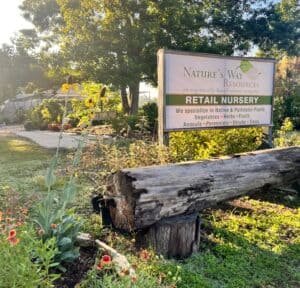
— Nature’s Way Resources offers free guided tours of NWR’s extensive nursery/soil/mulch facilities for garden clubs, plant societies and other plant-oriented, organized groups. As usual, NWR’s now-expanded meeting site is free to above groups. Reservations a must for both. Great time to visit.
- GOOD NEWS FOR BUSY/LAZY GARDENERS: Curbside pickup is now available in the Nature’s Way Resources nursery, and we’re offering plant preorders for special requests. Call in your order, pick it up when it works for you, or let us try to source the plants you’re looking for on upcoming shipments. Find inventory sheet here.
Want to receive The Lazy Gardener & Friends weekly newsletter?
John’s Corner
NEWS FROM THE WONDERFUL WORLD OF SOIL AND PLANTS
We are proud to announce a new sponsor and collaborator for our Lazy Gardener and Friends Newsletter — Laura Neff of
Founder of the Rice Organization, Inc., and Vice President of OHBA, Laura Neff will be a new monthly contributor here in John’s Corner beginning this week. We are grateful for her partnership, expertise, and the new insights she will bring to our newsletter.
Going Organic: It’s Not Just About
What You Stop Using
By Laura Neff
Owner of The Rice Organization, Inc., Organic Landscape Company
Vice President of The Organic Horticulture Benefits Alliance (OHBA)
I have a confession to make: I wasn’t always organic.
When I started my landscaping company more than 30 years ago, I did what most people in our industry did. If there were weeds, there was something to spray on them. Bugs? There was something for that too. And if a plant wasn’t looking quite green enough, surely there was a fertilizer in a bag that could fix it. That was landscaping—or at least, that was what I had been taught landscaping was.
Over the years, people like Mike Serant of MicroLife and my dear friend and mentor, the late John Ferguson of Nature’s Way Resources, taught me to look at landscapes very differently. Instead of asking, “What product do I need to fix this problem?” I learned to ask, “Why is this problem happening in the first place?” That one question changed the way I landscape.
Organic Is More Than Not Spraying
When people hear “organic landscaping,” they often think it simply means we don’t use synthetic pesticides, herbicides, or fertilizers. That’s certainly part of it. My company doesn’t use them. But going organic isn’t just about what you take away. It’s about what you put back.
We feed the soil. We add quality compost and organic matter. We mulch. We use organic fertilizers and amendments when they’re needed. We pay attention to drainage and irrigation. We choose plants that actually belong in the conditions where we’re putting them. And most importantly, we try to create soil that is alive.
Because underneath every healthy landscape is an entire world most of us never see. Bacteria, fungi, protozoa, nematodes, earthworms, and countless other organisms are working beneath our feet. They break down organic matter, cycle nutrients, and help create the soil structure plants need to develop healthy root systems. Once I began to understand that, landscaping made a whole lot more sense.
Sometimes the Bug Isn’t the Problem
One of the biggest changes in my thinking involved insects. Thirty years ago, if I saw bugs eating a plant, my first thought was: Kill the bugs. Today, my first thought is: What’s going on with the plant?
Is it stressed? Is it getting too much water—or not enough? Was it planted in the wrong location? Is the soil compacted? Does it have a healthy root system? And sometimes my answer is simply: Leave the bug alone.
That can be a hard sell. We have become so accustomed to thinking that any insect eating a leaf is a problem that needs to be solved. But a garden without insects isn’t a healthy ecosystem. Those caterpillars eating your plants may become butterflies and moths. Other insects become food for birds. Beneficial insects help keep pest populations in check. If we kill everything we don’t like, we often kill the very creatures that were helping us.
Organic Doesn’t Mean Perfect
This may be my favorite part: an organic landscape isn’t supposed to be perfect. There might be a few weeds. A leaf may have a hole in it. Your lawn may not resemble the putting green at Augusta National. And that’s okay.
I would much rather see a little insect damage in a garden full of birds, butterflies, and life than a chemically maintained landscape where nothing moves. Nature is not particularly tidy.
Start With the Soil
If someone asks me today where to begin going organic, my answer is almost always the same: Start with your soil.
Add good compost. Keep the soil covered with quality mulch. Stop applying products that can disrupt the biology you’re trying to encourage. Water deeply and appropriately rather than constantly. Choose plants suited to your soil, sunlight and our Houston climate. And give it time.
Healthy soil isn’t created overnight, and years of conventional practices aren’t undone with one application of compost. But nature is remarkably resilient when we stop fighting it and start working with it. I know because I’ve seen it happen in landscape after landscape—and I’ve seen it happen in my own garden.
More than 30 years into this business, I’m still learning. That’s one of the things I love most about horticulture. The more you understand about what is happening beneath your feet, the more you realize how much there still is to learn.
John knew that better than almost anyone. So perhaps the best way I can begin writing in this little corner that bears his name is with one of the most important lessons people like John taught me: Don’t just treat the symptom. Ask why it’s happening.
The answer is very often right under your feet.
Download the Original Newsletter Issue Below!
Sponsorship
If you are interested in becoming a sponsor, please contact us at 936-273-1200 or send an e-mail to: lazygardenerandfriends@gmail.com
About Us
BRENDA BEUST SMITH
WE KNOW HER BEST AS THE LAZY GARDENER . . .
but Brenda Beust Smith is also:
- a national award-winning writer & editor
- a nationally-published writer & photographer
- a national horticultural speaker
- a former Houston Chronicle reporter
When the Chronicle discontinued Brenda’s 45-year-old Lazy Gardener” print column — started in the early ’70s as a fun side-project to reporting, it then ranked as the longestrunning, continuously-published local newspaper column in the Greater Houston area. The name, she says, is not just fun, it’s true.
Brenda’s gradual sideways step from reporter into gardening writing led first to an 18-year series of when-to-do-what Lazy Gardener Calendars, then to her Lazy Gardener’s Guide book which morphed into her Lazy Gardener’s Guide on CD, which she now emails free upon request.
Brenda became a Harris County Master Gardener and, over the years, served on theboards of many Greater Houston area horticulture organizations. She hosted local radio and TV shows, most notably a 10+-year Lazy Gardener specialty shows on HoustonPBS (Ch. 8) and her call-in “EcoGardening” show on KPFT-FM.
For over three decades, Brenda served as Assistant Production Manager of the GARDEN CLUB OF AMERICA’S “BULLETIN” magazine. Although still an active broad-based freelance writer, Brenda’s main focus now is THE LAZY GARDENER & FRIENDS HOUSTON GARDEN NEWSLETTER with John Ferguson and Pablo Hernandez of Nature’s Way Resources.
A native of New Orleans and graduate of St. Agnes Academy and the University of Houston, Brenda lives in Humble, TX, and is married to the retired Aldine High School Coach Bill Smith. They have one son, Blake.
Regarding this newsletter, Brenda is the lead writer, originator of it and the daily inspiration for it. We so appreciate the way she has made gardening such a fun way to celebrate life together for such a long time.
About her column, Brenda says: “I don’t consider myself a ‘garden writer.” I started out 50+ years ago as a very lazy “gardening reporter.” I still feel that way today. I hope my columns inspire/help newcomers, but I do not write to them. I write to very experienced gardeners who want to expand their horizons.
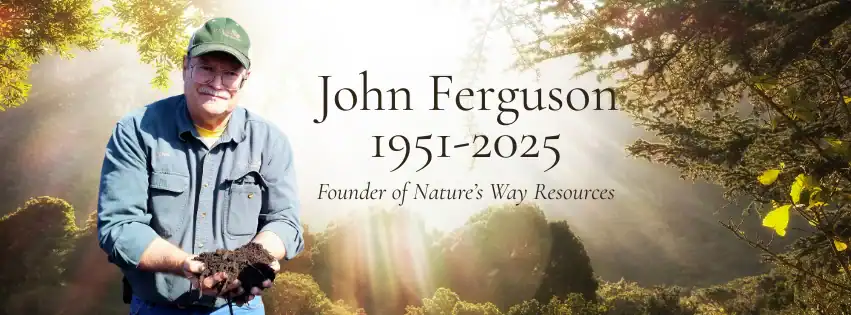
JOHN FERGUSON (1951-2025)
John was a native Houstonian with more than 35 years of business experience. He founded Nature’s Way Resources, a composting company known for producing high-quality compost, mulch, and soil mixes. He held an MS in Physics and Geology and was a licensed Soil Scientist in Texas.
Throughout his career, John received numerous awards in horticulture and environmental work. He represented the composting industry for many years on the Houston-Galveston Area Council for solid waste. His personal garden was featured in several horticultural books and in Better Homes and Gardens. His business was recognized by The Wall Street Journal for the quality and value of its products. He was a member of the Physics Honor Society and several professional organizations, and he co-authored Organic Management for the Professional.
John contributed articles regularly to this newsletter and oversaw its publication. We continue to share his past articles each week alongside The Lazy Gardener column to keep his passion, knowledge, and spirit alive for our readers.
SHELBY CASSANO is the communications and marketing lead for Nature’s Way Resources and the editor of The Lazy Gardener and Friends newsletter. Through her business, Leaf and Ledger, she exclusively partners with NWR to direct all marketing efforts, from campaign strategy and content planning to technical production of the newsletter. Shelby holds a B.S. in Agriculture with a concentration in Horticulture from Stephen F. Austin State University and previously managed the company’s nursery.

NATURE’S WAY RESOURCES
101 Sherbrook Cir.
Conroe, TX 77385
Hours of Operation
Monday – Friday: 8AM to 5PM
Saturday: 8AM to 2PM
Copyright © 2024 Nature’s Way Resources | All rights reserved.