
Nature’s Way Resources is proud to bring you this free weekly newsletter. While we don’t run ads, generous sponsors help support this project as a public service. Their names are listed below, please consider showing your appreciation by supporting their businesses!
Nature’s Way Resources honors the contributions of our late owner, John Ferguson. “The Lazy Gardener” Brenda Beust Smith and Shelby Cassano welcome your feedback and remain grateful to the many horticulturists who share their expertise.
Published September 23, 2026
Didn’t see many hummers this year? Then you’ll be interested in this Tip o’ the Trowel to a great Houston gardener, Doris Heard, who shared these tips from true hummingbird lovers on a trip with Birds Houston (formerly Houston Audubon) a number of years ago to a residence north of Houston where they had “…hundreds of hummingbirds visiting more than 15 feeders.” Among the tips, homeowners shared some interesting information with us:
- Place your feeders on the north side of your home. Since the hummingbirds are migrating south, they have an easier time spotting the feeders as they fly through.
- The hummingbirds arrive in a particular order: first the young males, then the older males and the young females, and finally the old females!
We’re now in our primary migration-back-to-Mexico peak, but not only does this apply to most (but not ALL!) migrating hummers; it also ignores the fact that many overwinter here. Just a reminder not to be too quick to take your feeders down.
Hope 2026 hasn’t flown past as quickly as mine has. One uplifting thought: our fall is (sometimes) a lot cooler than what we’ve just been through. This week we might even drop down into the low 90’s!!!
October, most local experts happily predict, is absolutely our best planting time, especially for most edibles. And, according to experts, it’s brought some pleasant surprises to home gardeners. Some plants that piddled along in the past suddenly started growing! They liked the heat! Any examples from your yard to share?
Much as our recent heat has probably shocked some newcomers, this has been statewide, but (taking my life in my hands) I’m going to again warn newcomers not to rely solely on statewide gardening advice. The “Greater Houston” covers 10,000+ sq miles! We are NOT like El Paso or Brownsville, which we all can understand. But we’re also not like Tyler (northeast Texas) in that we have higher humidity, milder winters, and more rainfall. Dallas, with its higher elevation and lower Gulf input, has colder weather and not as much rainfall. Our humidity is higher than almost anywhere else in the state.
Plants do react to these things, even though they seem minor. Hence, I always recommend you use HOUSTON-local gardening advice. It certainly abounds here! Your local nursery wants your business, so it’s always a great place to ask. And you can’t beat joining, or at least being aware of, your local Master Gardener Extension Garden.
Other common tips:
- Water deeply and you can do it less often. It’s still blasting hot out there, and a lot of plant watering (especially while the sun’s still high) starts evaporating before it ever hits the ground. Put that nozzle down close to the plant’s base and let it seep in.
- For us, most perennials, shrubs, and bulbs will love going in the ground in October. It will still be hot, so you’ll have to water, but roots will be forming that can more easily take our vacillating winter temperatures.
- Into tulips, hyacinths, and other “Holland” bulbs? These need far more cold than we can provide, so success depends on providing that BEFORE you plant. Place bulbs in paper sacks in the refrigerator, not touching the walls. You’ll get a ton of advice on how long to leave them there, but make sure it’s at least 6 weeks before spring plantings.
- If you’ve been putting off planting new trees (SMART!), it’s ok now. Just check first with knowledgeable sources to see if it’s a good variety for us and for YOUR part of the Greater Houston area!
- Our weather is NOT like the rest of the country or even like the rest of Texas in many cases. If you have doubts, consult your local independent nurseryman (he wants your success so you’ll come back!) and/or your area Master Gardeners. ALL have MG gardens at County Extension sites and welcome visitors, along with growing advice for your specific area.
- Into edibles? For newcomers and folks wanting to expand their edibles, this is the best place to start!
- Don’t forget the big Garden Club of Houston’s Bulb & Plant Mart is coming up Oct. 8-10, 2026 *Thurs., Oct. 8 (5–7 pm); Fri., Oct, 9 (9am– 4pm). Sat., Oct. 10, 9am–1pm. The Church of St. John the Divine, 2450 River Oaks Blvd Houston. Best tip: Read up on what’s available (pictures included!) and all the sale/preordering rules BEFORE you go. Click here for the free 2025 GCH BPM Horticulture Guide. Especially helpful are the already-posted plants for sale. Bulb Mart proceeds have benefitted all of us and Houston life in general! Good read: Fascinating history also on website.
In meantime, hasn’t this been a HORRENDOUS summer! I would really love to share with all of our readers which of your plants actually laughed at the heat? lazygardenerbrenda@gmail.com. Picture’s welcome! Now, don’t miss our pre-Halloween Spotlight Article on plants with Spooky backstories!
* * *

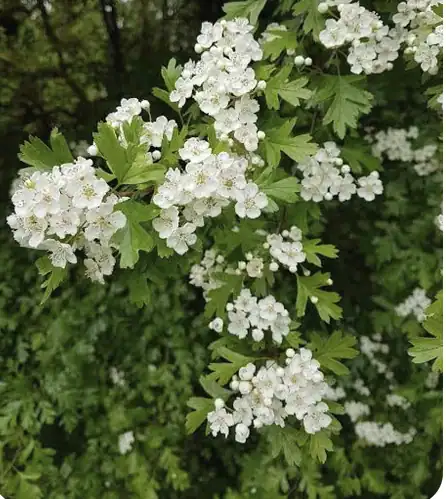
In ancient Celtic lore the hawthorn tree (we locals call it called Mahaw) is said to be a mystical gateway to the lands of fairies and the Underworld!
A BOTANICAL VIEW
OF HALLOWEEN!
BY ZOE MATRANGA
MERCER BOTANIC GARDENS & ARBORETUM
What would Halloween be without vampires, witches, and jack-o’-lanterns? Surprisingly, a lot less botanical! Plants play important roles in many spooky folktales.
The modern idea of vampires came from Central and Eastern Europe. One of the classic ways to defeat a vampire is with a wooden stake through the heart, but it matters which tree the wood comes from! Often, a stake is made from a hawthorn tree (Crataegus spp.), referred to locally as a mayhaw. Hawthorn is effective because it can pin a vampire down in their coffin, likely because of the long thorns the tree produces. There is a folk tradition in the Balkans of burying the dead with a hawthorn branch, as the thorns will prevent them from rising as vampires.
What does a witch have to do with a potato? Potatoes are members of the nightshade family, named after deadly nightshade, Atropa belladonna. Atropa is from Atropos, a figure in Greek mythology who decides how and when you die. Nightshade was said to be a key ingredient in a Witches Ointment, a potion that allowed witches to fly. The plant contains hallucinogenic compounds, which may go some way towards explaining the feeling. Though nightshade doesn’t grow here in Houston, its similarly toxic relatives, the angel’s trumpet (Brugmansia spp.) and devil’s trumpet (Datura spp.), are common in local gardens.
Whether you’re growing your own or buying from a store, carving a pumpkin is a beloved fall activity that mixes folklore from abroad with plants that have sustained Americans for millennia. Halloween can be traced to Samhain, a festival for the end of harvest and beginning of winter, when spirits could roam.
When immigrants from Ireland came to the US, they brought a folktale about a spirit trapped on earth carrying a lantern made of a turnip. He was known as “Jack of the Lantern.” The people of North America have been growing gourds for food, decoration, and tools for thousands of years, and their association with harvest season made pumpkins the new face of Jack.
Plants are part of what makes Halloween a creative and unique holiday. I wish you a bountiful harvest and a botanical Halloween!
EDITOR’S NOTE: Zoe’s upcoming tours would be a great way to learn more about Mercer if you’ve never been and a wonderful look at all the different aspects of this treasure. pct3.com/Explore/Mercer-Arboretum-Botanic-Gardens:
Upcoming Plant Walk & Garden Tour dates. First Saturday of every month from 10AM-11AM, and they are walking tours of the garden. The next three are:
- Spooky Plants (Oct 3, 10AM at Mercer Botanic Gardens Visitor Center): Learn about unusual plants and the eerie folklore they have inspired.
- Botany of Thanksgiving (Nov 7, 10AM at Mercer Botanic Gardens Visitor Center): Celebrate autumn’s bounty with plants.
- Winter Wonderland (Dec 5, 10AM at Mercer Botanic Gardens Visitor Center): Learn about plants that get us in the holiday spirit.
* * *

ATTN:
— Nature’s Way Resources offers free guided tours of NWR’s extensive nursery/soil/mulch facilities for garden clubs, plant societies and other plant-oriented, organized groups. As usual, NWR’s now-expanded meeting site is free to above groups. Reservations a must for both. Great time to visit.
- GOOD NEWS FOR BUSY/LAZY GARDENERS: Curbside pickup is now available in the Nature’s Way Resources nursery, and we’re offering plant preorders for special requests. Call in your order, pick it up when it works for you, or let us try to source the plants you’re looking for on upcoming shipments. Find inventory sheet here.
Want to receive The Lazy Gardener & Friends weekly newsletter?
John’s Corner
NEWS FROM THE WONDERFUL WORLD OF SOIL AND PLANTS
This article has been condensed for clarity and ease of reading.
Stop Volcano Mulching Your Trees
By John Ferguson, Founder, Nature’s Way Resources
Published Posthumously
Since we have been discussing mulches, it seems like a good time to talk about a common landscaping practice that can seriously harm trees: piling mulch around the trunk, commonly called “volcano mulching.”
It may look neat and tidy, but it is very harmful to trees, and this practice is prohibited in some states and municipalities.
This is especially important for new homeowners. If you have recently purchased a home, take a walk around your property and look at the trees. You may inherit landscaping practices from a previous owner that need to be corrected.
Why Is Volcano Mulching Harmful?
A tree has two different types of bark.
The rough bark found above ground is designed to protect the trunk in a relatively dry environment. It is naturally resistant to fire, insects, and microbial degradation.
The bark covering the roots is different. It is generally smoother and thinner and is adapted to living in the moist environment of the soil.
When mulch or soil is piled against the root flare and trunk, the trunk bark is exposed to a moist environment that it was never designed to withstand for long periods.
The bark can soften and begin to deteriorate. Once this happens, insects, disease organisms, and rodents have an easier opportunity to damage the tree.
Over time, the tree becomes stressed and weakened. What may have started as a simple landscaping practice can eventually contribute to serious tree health problems and, in severe cases, tree death.
Don’t Let Mulch Hide the Root Flare
When applying mulch around a tree, the root flare and trunk should remain exposed.
Mulch should be spread around the tree rather than piled against it. The goal is to protect and improve the soil around the roots, not to cover the trunk.
This is particularly important for new homeowners who may be planning their first landscaping project. Before adding mulch, inspect existing trees and correct any volcano mulching that may already be present.
Choose Your Landscaper Carefully
If you are hiring someone to landscape your property, ask to see photographs of their previous work.
Look at how they mulch around trees.
If you consistently see large piles of mulch covering tree trunks and root flares, that is a warning sign that they may not understand proper tree care.
A good landscaper should understand that mulch belongs around the tree, not on the tree.
And remember: correcting volcano mulching is much easier than replacing a mature tree that has been slowly damaged for years.
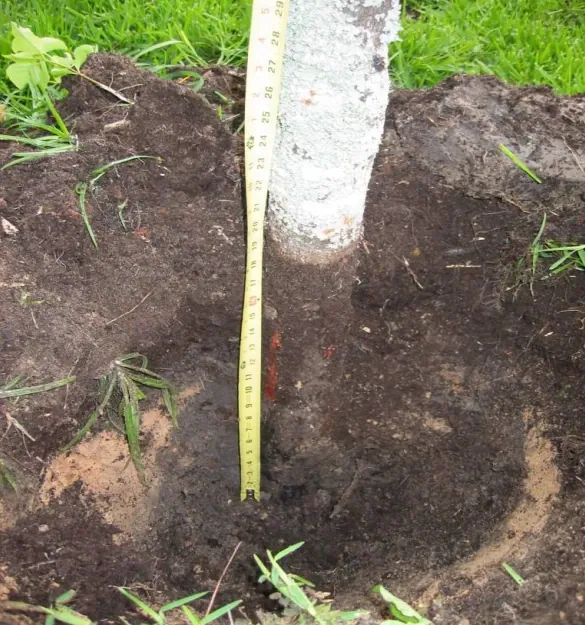
The photograph accompanying this article, provided by Howard Garrett, shows a tree that died after its trunk was covered. Notice how the bark has rotted away.
When mulching your trees, remember: keep the trunk and root flare exposed.
Download the Original Newsletter Issue Below!
Sponsorship
If you are interested in becoming a sponsor, please contact us at 936-273-1200 or send an e-mail to: lazygardenerandfriends@gmail.com
About Us
BRENDA BEUST SMITH
WE KNOW HER BEST AS THE LAZY GARDENER . . .
but Brenda Beust Smith is also:
- a national award-winning writer & editor
- a nationally-published writer & photographer
- a national horticultural speaker
- a former Houston Chronicle reporter
When the Chronicle discontinued Brenda’s 45-year-old Lazy Gardener” print column — started in the early ’70s as a fun side-project to reporting, it then ranked as the longestrunning, continuously-published local newspaper column in the Greater Houston area. The name, she says, is not just fun, it’s true.
Brenda’s gradual sideways step from reporter into gardening writing led first to an 18-year series of when-to-do-what Lazy Gardener Calendars, then to her Lazy Gardener’s Guide book, which morphed into her Lazy Gardener’s Guide on CD, which she now emails free upon request.
Brenda became a Harris County Master Gardener and, over the years, served on the boards of many Greater Houston area horticulture organizations. She hosted local radio and TV shows, most notably Lazy Gardener specialty fundraisers on HoustonPBS (Ch. 8) and her call-in “EcoGardening” show on KPFT-FM.
For over three decades, Brenda served as Assistant Production Manager of the GARDEN CLUB OF AMERICA’S “BULLETIN” magazine. Although still an active broad-based freelance writer, Brenda’s main focus now is THE LAZY GARDENER & FRIENDS HOUSTON GARDEN NEWSLETTER with Shelby Cassano of Nature’s Way Resources.
A native of New Orleans and graduate of St. Agnes Academy and the University of Houston, Brenda lives in Humble, TX, and is married to the retired Aldine High School Coach Bill Smith. They had one son, Blake.
Regarding this newsletter, Brenda is the lead writer, originator of it, and the daily inspiration for it. We so appreciate the way she has made gardening such a fun way to celebrate life together for such a long time.
About her column, Brenda says: “I don’t consider myself a ‘garden writer.’ I started out 50+ years ago as a very lazy ‘gardening reporter’.” I still feel that way today. I hope my columns inspire/help newcomers, but I do not write to them. I write to very experienced gardeners who want to expand their horizons.
JOHN FERGUSON (1951-2025)
John was a native Houstonian with more than 35 years of business experience. He founded Nature’s Way Resources, a composting company known for producing high-quality compost, mulch, and soil mixes. He held an MS in Physics and Geology and was a licensed Soil Scientist in Texas.
Throughout his career, John received numerous awards in horticulture and environmental work. He represented the composting industry for many years on the Houston-Galveston Area Council for solid waste. His personal garden was featured in several horticultural books and in Better Homes and Gardens. His business was recognized by The Wall Street Journal for the quality and value of its products. He was a member of the Physics Honor Society and several professional organizations, and he co-authored Organic Management for the Professional.
John contributed articles regularly to this newsletter and oversaw its publication. We continue to share his past articles each week alongside The Lazy Gardener column to keep his passion, knowledge, and spirit alive for our readers.
SHELBY CASSANO is the communications and marketing lead for Nature’s Way Resources and the editor of The Lazy Gardener and Friends newsletter. Through her business, Leaf and Ledger, she exclusively partners with NWR to direct all marketing efforts, from campaign strategy and content planning to technical production of the newsletter. Shelby holds a B.S. in Agriculture with a concentration in Horticulture from Stephen F. Austin State University and previously managed the company’s nursery.

NATURE’S WAY RESOURCES
101 Sherbrook Cir.
Conroe, TX 77385
Hours of Operation
Monday – Friday: 8AM to 5PM
Saturday: 8AM to 2PM
Copyright © 2024 Nature’s Way Resources | All rights reserved.