
Nature’s Way Resources is proud to bring you this free weekly newsletter. While we don’t run ads, generous sponsors help support this project as a public service. Their names are listed below, please consider showing your appreciation by supporting their businesses!
Nature’s Way Resources honors the contributions of our late owner, John Ferguson. “The Lazy Gardener” Brenda Beust Smith and Shelby Cassano welcome your feedback and remain grateful to the many horticulturists who share their expertise.
Published August 12, 2026
Or, maybe, if she’s in a really good mood, she might turn the tables by opening a whole new gardening door! GARY McMILLAN cheerfully admits he wasn’t much of a gardener back when he decided to make some changes at his 27-year “Woodcreek” home . . . The last thing he expected was an eye-popping “garden” that would literally come to him!
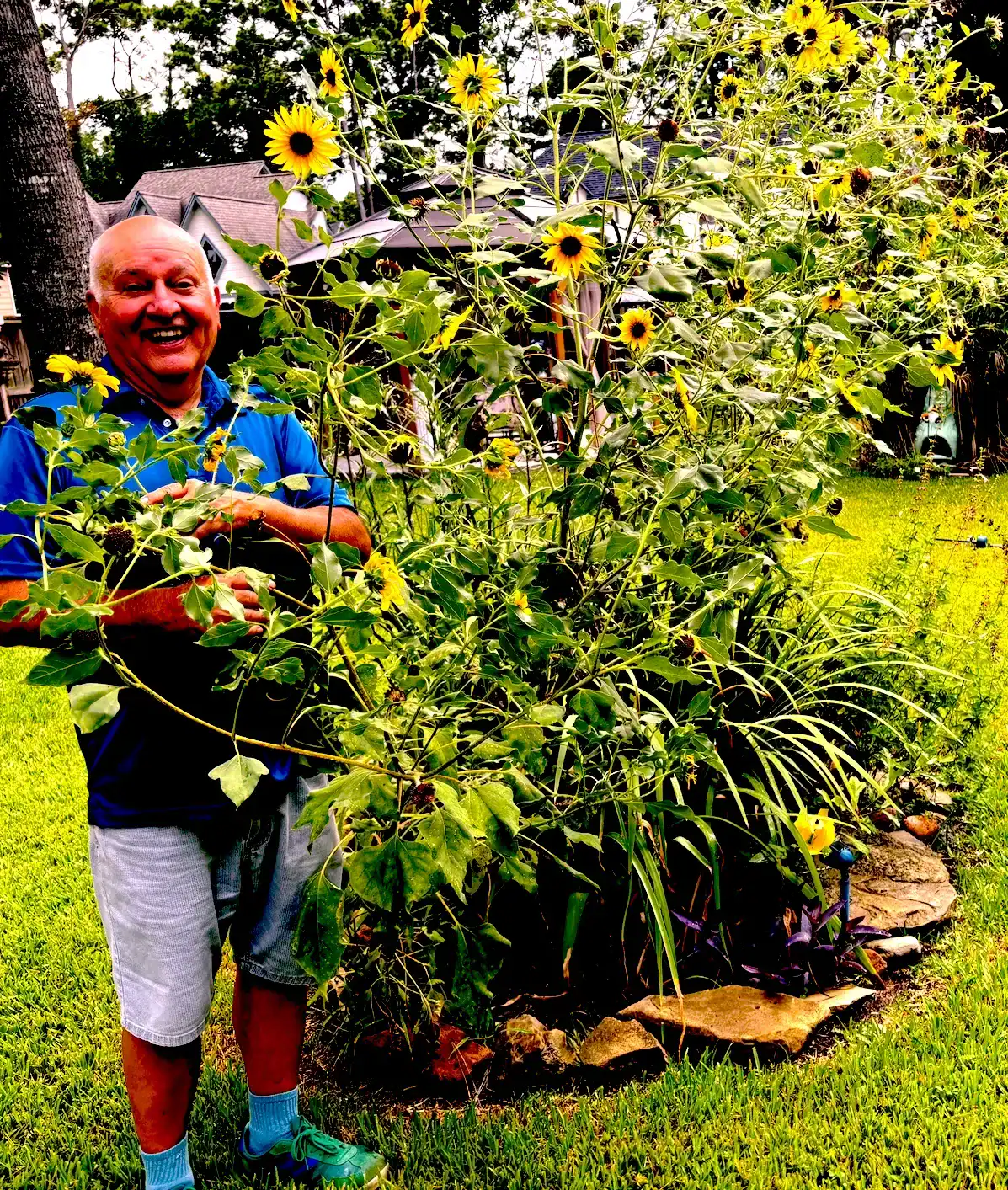
“When I redid my driveway, the contractor pushed some dirt into the corner of my backyard,” Gary explains.
Although Gary describes himself a non-gardener, he was fascinated by the beauties. More began appearing and eventually the newcomers “migrated across the yard. I just let them grow. That’s how I have so many!”
Now the gardening bug has bitten! Gary’s doing his own transplanting, and adding new flowering choices at the same time!
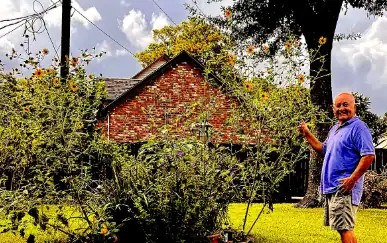
A little warning before you try filling your yard with them, our native sunflowers can grow up to 30 feet tall. Young & middle aged sunflowers really do “track the sun” (heliotropism), rotating their “faces” from east to west as the sun moves across the sky (nature’s timekeepers!). At night, the “faces” rotate back to the east.
Like us, the older plants get, the less “rotating” they do! Interesting note, it’s a growth thing. Daytime growth happens only on the west side. At night, growth happens on the east side, putting them in position for maximum growth. Look it up. There are even more neat aspects to their growth patterns!
Who else would tell you these things? EG., tallest sunflower documented so far was in Germany, 30+’ tall!
* * *
SECRET TO FALL GARDENING
SUCCESS IN GREATER HOUSTON?
USE LOCAL RESOURCES!
WHAT A WEATHER MERRY-GO-ROUND we’ve been on! Does my heart good to see plants that just yawn at our up-and-down, too-dry/too-wet/MUCH-too-hot summers!
If there’s one lesson to be learned (at least by “lazy gardeners”) from Mother Nature, it’s “Do it MY way, folks . . .or be prepared to pay the price!”
What does that mean? It means: LOOK AROUND! After our recent high heat spell, what still looks wonderful? What doesn’t?
Hot as it is, this is a great time to be visiting public gardens. (Google “Greater Houston Public Gardens” and especially listings for your specific area.) Go to your closest ones (you share growing conditions) in early morning or late evening if possible on the coolest (ok, HA!) coming day.
The whole point is to see what they’ve planted and/or will be planting for beautiful (or producing) fall displays.
Fall plantings are starting to go in. These sites (usually) don’t have expansive funds to waste on plants that aren’t geared to our climate, especially those in your general area.
Just remember, what’s great for our far west area might have very different plants from east, north, and south Greater Houston areas.
Perhaps most important is to see what edibles (and ornamentals) your local Master Gardeners are now planting in their demonstration gardens. What varieties? Plants will be labeled, and garden volunteers working who are always happy to answer questions.
Be sure to check our calendar below for dates of these and other gardening groups’ upcoming plant sales (always check our calendar below)! Your success is their success, so don’t be shy about asking questions! Pick up info on how to join!
AS SHOCKING AS IT MAY BE to newcomers (especially from northern areas), lots of vegetables and other edibles should be planted in August here, including Urban Harvest Planting Guides.
These valuable guide recommendations don’t change much from year to year — but actual notes and planting advice may. So if 2026 isn’t out, just use 2025. Free downloads. But DO take time to review this incredible resource. It will be worth every cent joining costs and save you a LOT of expensive gardening mistakes!!!!
* * *

ATTN:
— Nature’s Way Resources offers free guided tours of NWR’s extensive nursery/soil/mulch facilities for garden clubs, plant societies and other plant-oriented, organized groups. As usual, NWR’s now-expanded meeting site is free to above groups. Reservations a must for both. Great time to visit.
- GOOD NEWS FOR BUSY/LAZY GARDENERS: Curbside pickup is now available in the Nature’s Way Resources nursery, and we’re offering plant preorders for special requests. Call in your order, pick it up when it works for you, or let us try to source the plants you’re looking for on upcoming shipments. Find inventory sheet here.
Want to receive The Lazy Gardener & Friends weekly newsletter?
John’s Corner
NEWS FROM THE WONDERFUL WORLD OF SOIL AND PLANTS
This article has been condensed for clarity and ease of reading
Microbes, Minerals and Rare Earth Elements
By John Ferguson
Founder of Nature’s Way Resources
Posthumous article
Every day we are learning more about the importance of microbes in our soils and their role in helping plants remain healthy.
For example, many soils have limited iron (Fe) availability, which can restrict plant growth. Sometimes there simply isn’t enough iron in the soil. In other cases, the iron is present but chemically locked into mineral forms that plants cannot absorb.
Researchers at the Max Planck Institute for Plant Breeding Research have discovered that plants release signaling chemicals from their roots that attract certain species of bacteria. These bacteria help mobilize iron by breaking apart the chemical bonds holding it, making the iron available for the plant to absorb (Cell Host & Microbe, 2020).
This is another example of how plants and soil microbes work together to make nutrients available.
Rare Earth Elements
We often hear about the benefits of remineralizing our soils. One interesting group of elements is known as rare earth elements (REEs).
There are 17 rare earth elements: 15 lanthanides, along with scandium and yttrium.
A series of studies from China has found that, when present in soils at appropriate concentrations, some rare earth elements can stimulate plant growth, increase root production, and enhance the production of secondary plant compounds such as flavonoids and phenols.
Secondary metabolites are important compounds produced by plants for defense and protection from environmental stresses. Some are also being studied for their potential health benefits in humans.
Other research has specifically found positive effects from cerium (Ce), lanthanum (La), and praseodymium (Pr), including increased plant growth and stimulation of secondary metabolites. Some studies have also found increased root production at very low concentrations of rare earth elements (HortScience, 2020).
What About Scandium?
We rarely see scandium listed on a bag of fertilizer.
A few years ago, while studying the elements needed by plants and humans, I became interested in scandium. Research has found scandium in association with the amino acid proline, and it occurs in measurable concentrations in some plants.
Scandium has also been detected in a variety of plant tissues. One report found concentrations of approximately 5 parts per billion (ppb) in vegetables, 70 ppb in grasses, and as much as 140 ppb in tea leaves.
There has also been research into the use of scandium compounds in agriculture. Scandium sulfate (Sc₂(SO₄)₃), when applied as a dilute solution, has been studied as a seed-germination treatment for crops including corn, peas, and wheat. The research found an increase in the number of seeds that successfully germinated.
Scandium and Vitamin D
Vitamin D is well known for its importance to human health and immune function. Some research has proposed that scandium may interact with vitamin D metabolism or function, while other work has suggested that adequate boron may be important for the body’s utilization of scandium.
These relationships are an interesting reminder that nutrition is much more complicated than simply looking at a list of major nutrients. Plants and humans depend on a wide range of elements, microbes, and chemical interactions that we are still learning to understand.
The more we learn about soil minerals and the microbes that make those minerals available, the more we realize that healthy soil is a living system, not simply a collection of chemical nutrients.
Download the Original Newsletter Issue Below!
Sponsorship
If you are interested in becoming a sponsor, please contact us at 936-273-1200 or send an e-mail to: lazygardenerandfriends@gmail.com
About Us
BRENDA BEUST SMITH
WE KNOW HER BEST AS THE LAZY GARDENER . . .
but Brenda Beust Smith is also:
- a national award-winning writer & editor
- a nationally-published writer & photographer
- a national horticultural speaker
- a former Houston Chronicle reporter
When the Chronicle discontinued Brenda’s 45-year-old Lazy Gardener” print column — started in the early ’70s as a fun side-project to reporting, it then ranked as the longestrunning, continuously-published local newspaper column in the Greater Houston area. The name, she says, is not just fun, it’s true.
Brenda’s gradual sideways step from reporter into gardening writing led first to an 18-year series of when-to-do-what Lazy Gardener Calendars, then to her Lazy Gardener’s Guide book, which morphed into her Lazy Gardener’s Guide on CD, which she now emails free upon request.
Brenda became a Harris County Master Gardener and, over the years, served on the boards of many Greater Houston area horticulture organizations. She hosted local radio and TV shows, most notably Lazy Gardener specialty fundraisers on HoustonPBS (Ch. 8) and her call-in “EcoGardening” show on KPFT-FM.
For over three decades, Brenda served as Assistant Production Manager of the GARDEN CLUB OF AMERICA’S “BULLETIN” magazine. Although still an active broad-based freelance writer, Brenda’s main focus now is THE LAZY GARDENER & FRIENDS HOUSTON GARDEN NEWSLETTER with Shelby Cassano of Nature’s Way Resources.
A native of New Orleans and graduate of St. Agnes Academy and the University of Houston, Brenda lives in Humble, TX, and is married to the retired Aldine High School Coach Bill Smith. They had one son, Blake.
Regarding this newsletter, Brenda is the lead writer, originator of it, and the daily inspiration for it. We so appreciate the way she has made gardening such a fun way to celebrate life together for such a long time.
About her column, Brenda says: “I don’t consider myself a ‘garden writer.’ I started out 50+ years ago as a very lazy ‘gardening reporter’.” I still feel that way today. I hope my columns inspire/help newcomers, but I do not write to them. I write to very experienced gardeners who want to expand their horizons.
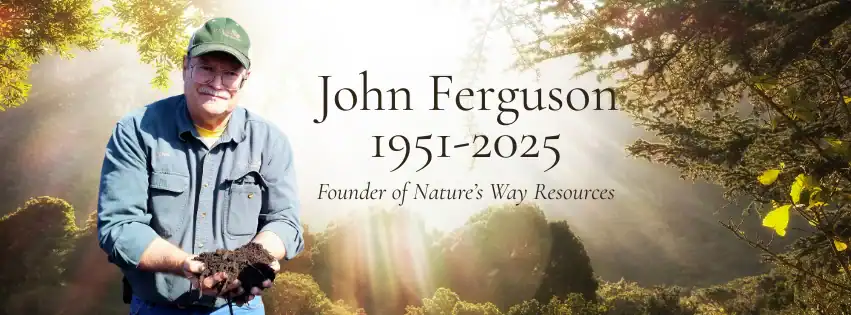
JOHN FERGUSON (1951-2025)
John was a native Houstonian with more than 35 years of business experience. He founded Nature’s Way Resources, a composting company known for producing high-quality compost, mulch, and soil mixes. He held an MS in Physics and Geology and was a licensed Soil Scientist in Texas.
Throughout his career, John received numerous awards in horticulture and environmental work. He represented the composting industry for many years on the Houston-Galveston Area Council for solid waste. His personal garden was featured in several horticultural books and in Better Homes and Gardens. His business was recognized by The Wall Street Journal for the quality and value of its products. He was a member of the Physics Honor Society and several professional organizations, and he co-authored Organic Management for the Professional.
John contributed articles regularly to this newsletter and oversaw its publication. We continue to share his past articles each week alongside The Lazy Gardener column to keep his passion, knowledge, and spirit alive for our readers.
SHELBY CASSANO is the communications and marketing lead for Nature’s Way Resources and the editor of The Lazy Gardener and Friends newsletter. Through her business, Leaf and Ledger, she exclusively partners with NWR to direct all marketing efforts, from campaign strategy and content planning to technical production of the newsletter. Shelby holds a B.S. in Agriculture with a concentration in Horticulture from Stephen F. Austin State University and previously managed the company’s nursery.

NATURE’S WAY RESOURCES
101 Sherbrook Cir.
Conroe, TX 77385
Hours of Operation
Monday – Friday: 8AM to 5PM
Saturday: 8AM to 2PM
Copyright © 2024 Nature’s Way Resources | All rights reserved.