
Nature’s Way Resources is proud to bring you this free weekly newsletter. While we don’t run ads, generous sponsors help support this project as a public service. Their names are listed below, please consider showing your appreciation by supporting their businesses!
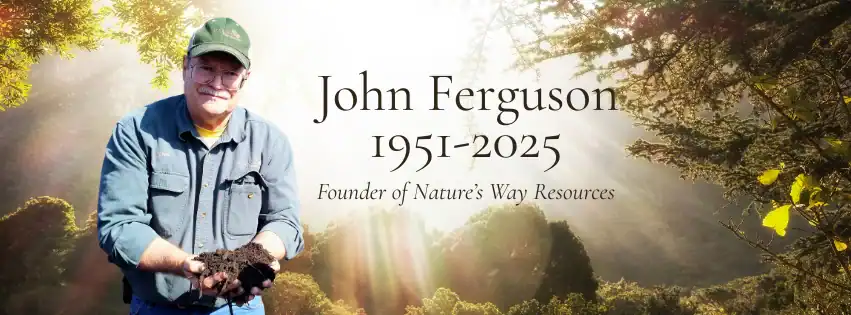
Nature’s Way Resources honors the contributions of our late owner, John Ferguson. “The Lazy Gardener” Brenda Beust Smith and Shelby Cassano welcome your feedback and remain grateful to the many horticulturists who share their expertise.
Published June 24, 2026
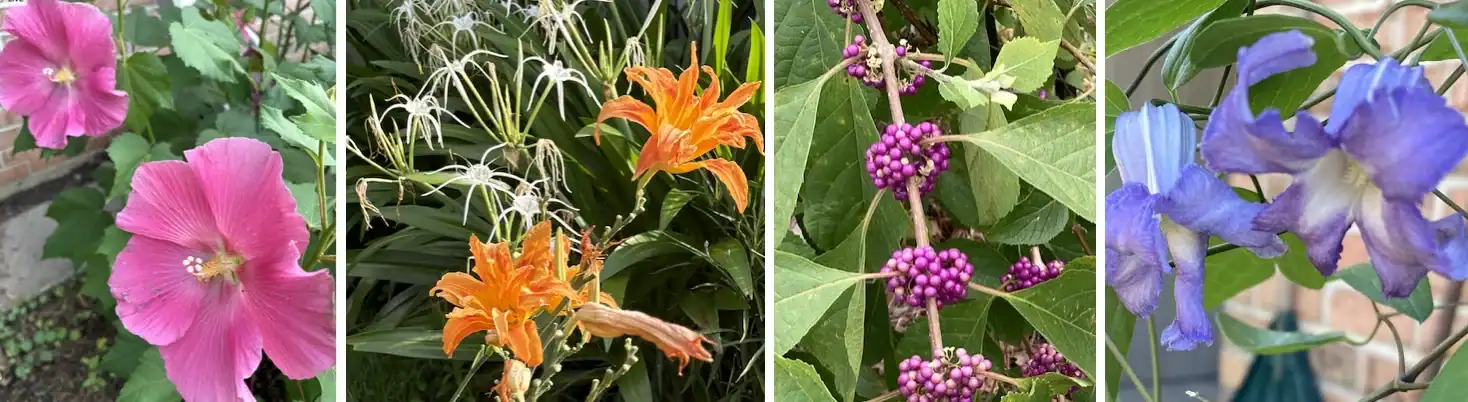
Hibiscus, Double Orange Day Lilies, American beautyberry and Clematis.
-
IT MAY SOUND CRAZY to talk about drought gardening after the downpours we’ve had lately, but forewarned is forearmed. Plenty of blasting hot weather ahead! In our now-distant past, that famous high temp mark usually occurred around July. Since we’re already sweating in the 90’s now, even higher temps are a sure bet soon.
We have to admire and respect plants that not only survive, but seem to LIKE our summers! But summers can be a shock to newcomers to gardening here. Normally, I write to experienced local gardeners, but we Texans are a friendly group.
Newcomers, especially those from far northern states, might be really grateful to hear which of your favorite plants have not only survived — but even BLOOMED — when temps climb well above 100º. (Remember when that used to raise eyebrows? Drew major headlines? Now it’s our norm!)
This is one time when — for significant plant investments — you WANT to shop where experienced nurserymen are on hand, who know how to carefully aim at our environment.
Seasoned gardeners are already getting ready, stocking up on children’s umbrellas (see below), higher-quality mulch, etc. It’s often newcomers who mostly get hit with heat-murdered beds “after ALL that work!!!”
SOME TIPS:
* Mulch helps stop the inevitable water evaporation, which, in turn, will help keep soil temps down. Without mulch, it’s not uncommon for topsoil to be bone dry by mid-afternoon.
* If you water by hand, stick the nozzle down as close to the main stalks as possible to soak immediately down to the roots and not be wasted or evaporated
• Sprinklers are handy if you don’t have time to do this. But remember, airborne streams of water in hot sun will lose a lot of water to evaporation.
* Soaker hoses are more efficient than sprinklers when temps are 90s or above.
Later on, it will get REALLY hot. Keep an eye out for ways to shade lower-growing flowers in early afternoon, when sun rays are really hammering down. West-side deflectors like children’s umbrellas, small tents, or other shading devices will help.
It may seem a little early to talk about all this now, but you’ll be glad later on. Debbie Starns (who first suggested children’s umbrellas to me) already has her Giant Ligularias (below) under these. (Purchased, she adds, at less than $10 each online).
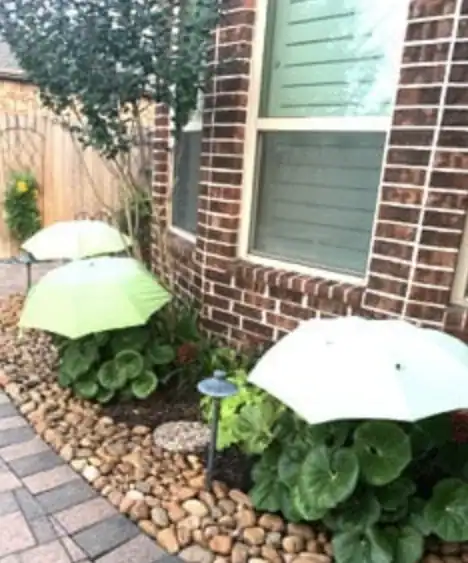
Debbie attaches them with painters’ tape to a 3 ft green pole.”Works great,” she reports, and warns, “Can’t hurt to be prepared, especially for your really treasured flora.”
Rains right now help our plants. But, later on, how can you tell if a flower is getting sunburned? Keep an eye out for fading colors, burnt flower edges, and droopy leaf edges. Problem is, by the time you notice, it may be too late. Better to water regularly.
SUMMER STARTED back when we hit a record high of 97º. Predictions of triple-digit heat now are more a probability than possibility — a real problem for plants, especially new ones, that haven’t had time to acclimate. This tip below drew so many great responses, figured a good one to repeat:
If heavy winds are a challenge, Debbie adds a 3-4′ shepherd’s hook to the green umbrella, so it won’t blow away
Only problems with the green umbrellas were:
1. “HIGH WINDS” Debbie solved that by attaching the umbrellas to a 3-4 foot green garden stake with a green twisty or attaching the umbrella to a 3-4 foot shepherd’s hook with a twisty. She reports that “Worked great!” And . . .
2. AFTER OUR ARTICLE RAN, small umbrellas became really hard to find!
Anyone have other heat protection solutions, or how to cope with high winds? They often accompany our rain episodes!
Email to lazygardenerBrenda@gmail.com.
* * *
JULY IN THE GARDEN This is a good time to look South for new, heat-loving plants. First of all, don’t look too far north of Texas for ideas. The farther north, the less likely suggestions will be intended for OUR heat. For really hardy plants, visit our great public gardens like Mercer Arboretum and Botanic Garden and Houston Botanic Garden
(Feel free to send suggestions of other great gardens to visit! I’ll share. lazygardenerbrenda@gmail.com. Pictures welcome!)
* * *

ATTN:
— Nature’s Way Resources offers free guided tours of NWR’s extensive nursery/soil/mulch facilities for garden clubs, plant societies and other plant-oriented, organized groups. As usual, NWR’s now-expanded meeting site is free to above groups. Reservations a must for both. Great time to visit.
- GOOD NEWS FOR BUSY/LAZY GARDENERS: Curbside pickup is now available in the Nature’s Way Resources nursery, and we’re offering plant preorders for special requests. Call in your order, pick it up when it works for you, or let us try to source the plants you’re looking for on upcoming shipments. Find inventory sheet here.
Want to receive The Lazy Gardener & Friends weekly newsletter?
John’s Corner
NEWS FROM THE WONDERFUL WORLD OF SOIL AND PLANTS
This article has been condensed for clarity and ease of reading, find the link to the original article below.
Mosquito Spraying, Weeds, and Working With Nature
by John Ferguson
In an issue of American Gardener, there was an excellent article on the myths surrounding mosquito spraying. We have known for years that mosquito spraying often makes mosquito problems worse, not better.
As the article states:
“Mosquito spraying propaganda follows a well-worn playbook of false product marketing: 1) name a target; 2) spread myths about that target; 3) invoke guilt by association about other misunderstood targets (usually ants and spiders); and 4) promise a paradisiacal existence once all targets are eliminated.”
It can take up to a million droplets of insecticide to kill a single mosquito.
Unfortunately, the spraying also kills beneficial insects and mosquito predators that do not reproduce nearly as quickly as mosquitoes. The result is often more mosquitoes over time, not fewer. These chemicals can also drift into our homes and have been linked to cognitive problems, reproductive issues, and increased cardiovascular risks.
Now that we are well into the growing season, weeds are becoming a common challenge for gardeners. Here are a few principles that can help keep them under control.
1. Prevention Starts With Healthy Soil
Many plants we call weeds are actually nature’s response to soil problems. Missing nutrients, soil compaction, low organic matter, excessive fertilization, and poor soil biology all encourage weeds.
Nature dislikes bare soil, which is why maintaining a good layer of mulch is one of the simplest and most effective weed-prevention strategies.
2. Start Early
Hand digging remains one of the best tools for controlling weeds, especially when they are young. This is particularly true for species such as nutgrass.
Early action is critical. Some weeds can multiply rapidly once established, making them much more difficult to control later.
3. Let Plants Compete
Weeds have a much harder time establishing where desirable plants are already thriving.
Established plants compete for water and nutrients while also providing shade.
Since many weed species are sun lovers, reducing available sunlight significantly weakens them.
4. Don’t Overwater
Most plants require oxygen in the soil for healthy root growth. When soils remain saturated, oxygen levels drop, and roots suffer.
When conditions become overly wet, Mother Nature often sends in her cleanup crew, what we call weeds, to help correct the imbalance.
5. Protect Beneficial Fungi
Many garden plants depend on fungal-rich soils. Unfortunately, tilling destroys fungal networks and favors bacteria-dominated soils.
Many common weeds thrive in bacterial-dominated conditions. Excessive tillage can unintentionally select for weeds while making conditions less favorable for many desirable plants.
When planting seeds or transplants, disturb the soil as little as possible.
6. Smother or Solarize
For large areas, solarization can be very effective. Cover the area with clear or black plastic and allow the sun’s heat to build beneath it. I prefer clear plastic because it allows more solar energy to penetrate and heat the soil. Once the vegetation underneath has died, the area is ready for planting.
Newspaper and cardboard can also be highly effective.
For newspaper, apply a layer at least five sheets thick, overlapping each section by one-third. Wet it thoroughly and cover with mulch. The combination blocks light and air while holding the paper firmly against the soil.
Cardboard works similarly. A single layer is usually sufficient as long as seams overlap enough to prevent shoots from emerging.
I prefer these methods because the dead vegetation, decomposed paper, and mulch all become part of the soil-building process.
7. Flame Weeders
One of my favorite tools is a flame weeder attached to a one-pound propane cylinder. Most models have an electric igniter and are very easy to use.
A brief one- to two-second exposure is often enough to kill small weeds. They work particularly well on patios, sidewalks, and driveway expansion joints.
8. Alternative Weed Killers
Agricultural vinegar is much stronger than household vinegar and can be used much like a conventional herbicide. Be careful, however, it will damage any plant it contacts.
Some gardeners use mixtures containing Everclear, vodka, or gin combined with water and a small amount of liquid soap as a surfactant. While I have read about this approach, I have not personally tested it.
Others simply use boiling water on weeds growing in cracks and expansion joints.
6 Great Tips for Growing Weeds
The Woodlands Water newsletter recently shared a humorous list titled “6 Great Tips for Growing Weeds.” While tongue-in-cheek, it makes some excellent points:
Don’t skimp on synthetic fertilizer
Cheap, non-organic fertilizers can reduce oxygen levels and beneficial soil organisms. Great for weeds, not so great for your plants.
Apply a full-spectrum fungicide
Your weeds will appreciate the bacteria-dominated soil that often follows.
Water a lot
Overwatering fills soil pore spaces, reduces oxygen, and creates conditions many weeds enjoy.
Use low-quality mulch
Cheap mulch with a high carbon-to-nitrogen ratio can weaken desirable plants while encouraging weed growth.
Use Roundup®
Weeds may dislike glyphosate in the short term, but research suggests it can alter soil biology in ways that favor future weed problems.
Rely on landscape fabric
Over time, organic matter accumulates on top of the fabric, creating an ideal seedbed for weeds. Eventually, the fabric deteriorates, and weed roots move right in.
The best long-term weed control is not a product; it’s healthy soil. When soil biology, fertility, moisture, and organic matter are balanced, weeds become far less of a problem.
Download the Original Newsletter Issue Below!
Sponsorship
If you are interested in becoming a sponsor, please contact us at 936-273-1200 or send an e-mail to: lazygardenerandfriends@gmail.com
About Us
BRENDA BEUST SMITH
WE KNOW HER BEST AS THE LAZY GARDENER . . .
but Brenda Beust Smith is also:
- a national award-winning writer & editor
- a nationally-published writer & photographer
- a national horticultural speaker
- a former Houston Chronicle reporter
When the Chronicle discontinued Brenda’s 45-year-old Lazy Gardener” print column — started in the early ’70s as a fun side-project to reporting, it then ranked as the longestrunning, continuously-published local newspaper column in the Greater Houston area. The name, she says, is not just fun, it’s true.
Brenda’s gradual sideways step from reporter into gardening writing led first to an 18-year series of when-to-do-what Lazy Gardener Calendars, then to her Lazy Gardener’s Guide book which morphed into her Lazy Gardener’s Guide on CD, which she now emails free upon request.
Brenda became a Harris County Master Gardener and, over the years, served on theboards of many Greater Houston area horticulture organizations. She hosted local radio and TV shows, most notably a 10+-year Lazy Gardener specialty shows on HoustonPBS (Ch. 8) and her call-in “EcoGardening” show on KPFT-FM.
For over three decades, Brenda served as Assistant Production Manager of the GARDEN CLUB OF AMERICA’S “BULLETIN” magazine. Although still an active broad-based freelance writer, Brenda’s main focus now is THE LAZY GARDENER & FRIENDS HOUSTON GARDEN NEWSLETTER with John Ferguson and Pablo Hernandez of Nature’s Way Resources.
A native of New Orleans and graduate of St. Agnes Academy and the University of Houston, Brenda lives in Humble, TX, and is married to the retired Aldine High School Coach Bill Smith. They have one son, Blake.
Regarding this newsletter, Brenda is the lead writer, originator of it and the daily inspiration for it. We so appreciate the way she has made gardening such a fun way to celebrate life together for such a long time.
About her column, Brenda says: “I don’t consider myself a ‘garden writer.” I started out 50+ years ago as a very lazy “gardening reporter.” I still feel that way today. I hope my columns inspire/help newcomers, but I do not write to them. I write to very experienced gardeners who want to expand their horizons.
JOHN FERGUSON (1951-2025)
John was a native Houstonian with more than 35 years of business experience. He founded Nature’s Way Resources, a composting company known for producing high-quality compost, mulch, and soil mixes. He held an MS in Physics and Geology and was a licensed Soil Scientist in Texas.
Throughout his career, John received numerous awards in horticulture and environmental work. He represented the composting industry for many years on the Houston-Galveston Area Council for solid waste. His personal garden was featured in several horticultural books and in Better Homes and Gardens. His business was recognized by The Wall Street Journal for the quality and value of its products. He was a member of the Physics Honor Society and several professional organizations, and he co-authored Organic Management for the Professional.
John contributed articles regularly to this newsletter and oversaw its publication. We continue to share his past articles each week alongside The Lazy Gardener column to keep his passion, knowledge, and spirit alive for our readers.
SHELBY CASSANO is the communications and marketing lead for Nature’s Way Resources and the editor of The Lazy Gardener and Friends newsletter. Through her business, Leaf and Ledger, she exclusively partners with NWR to direct all marketing efforts, from campaign strategy and content planning to technical production of the newsletter. Shelby holds a B.S. in Agriculture with a concentration in Horticulture from Stephen F. Austin State University and previously managed the company’s nursery.

NATURE’S WAY RESOURCES
101 Sherbrook Cir.
Conroe, TX 77385
Hours of Operation
Monday – Friday: 8AM to 5PM
Saturday: 8AM to 2PM
Copyright © 2024 Nature’s Way Resources | All rights reserved.