
Nature’s Way Resources is proud to bring you this free weekly newsletter. While we don’t run ads, generous sponsors help support this project as a public service. Their names are listed below, please consider showing your appreciation by supporting their businesses!
Nature’s Way Resources honors the contributions of our late owner, John Ferguson. “The Lazy Gardener” Brenda Beust Smith and Shelby Cassano welcome your feedback and remain grateful to the many horticulturists who share their expertise.
Published May 13, 2026
by Brenda Beust Smith | The Lazy Gardener
Karen McCarver sent in this picture of a redbud, but it’s no redbud I’ve ever seen. Nor she. It’s blooming, she wrote, in the Rice Military area (north of Memorial Dr./west of Shepherd Dr.) Couple of thoughts (with help of research):
1. Not typical Eastern redbud that we normally see around here. Maybe it’s a Mexican redbud?
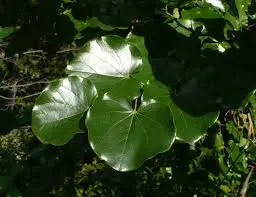
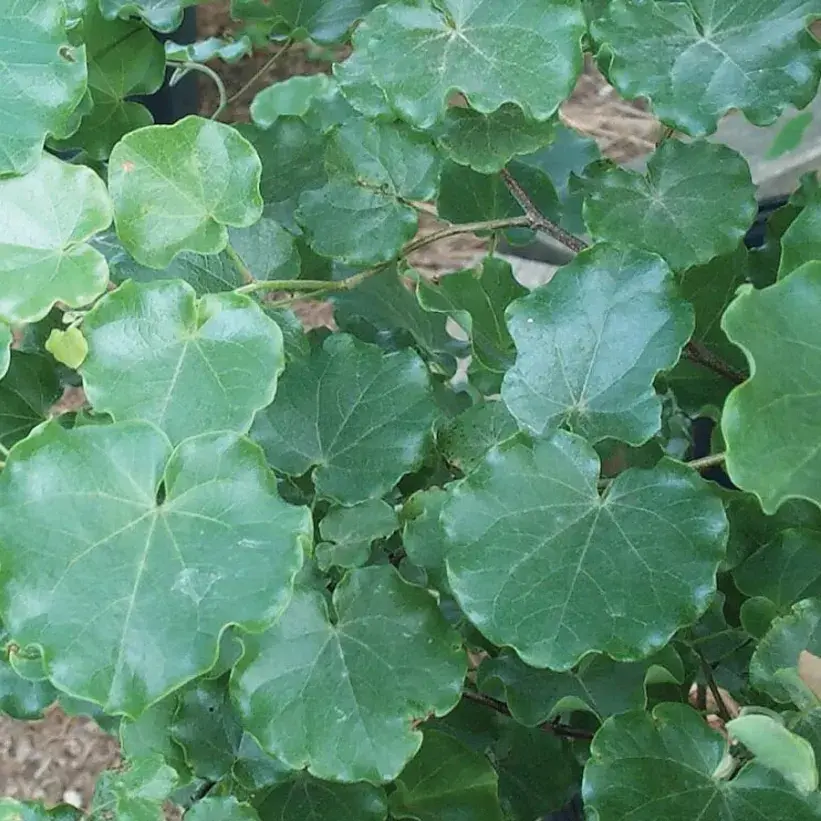
Mexican Redbud (left), source floridaseeds.com, Eastern Redbud (right), source Arbor Day Foundation
2. Last year’s drought has prompted incredible blooming this year (trauma-triggered production?) Plants don’t bloom for our enjoyment. They bloom to produce seed. After particularly rough-weather season (drought, Ike, etc.), often see unusually-large production – not to please us but to produce more seed because they’ve been so traumatized by threatening conditions, they think they’re going to die. Hence they produce lots of seed to continue the species.
But, since I made all that up, I turned to my plant ID guru (the now late, great) Suzzanne Chapman at Mercer Arboretum & Botanic Gardens for a “real” answer. She quoted (then) Mercer Director Darrin Duling: “Cauliflory is the botanical term that describes the occurrence of flowers and fruits growing directly from the main stem or trunk instead of from new growth and shoots. On young plants it doesn’t look that odd since flowers cover the branches, but is amazing to see on trunks of old trees. It is a new term to me, and more common with tropical trees.
Isn’t it nice to know our gurus constantly learn new stuff too?
* * *
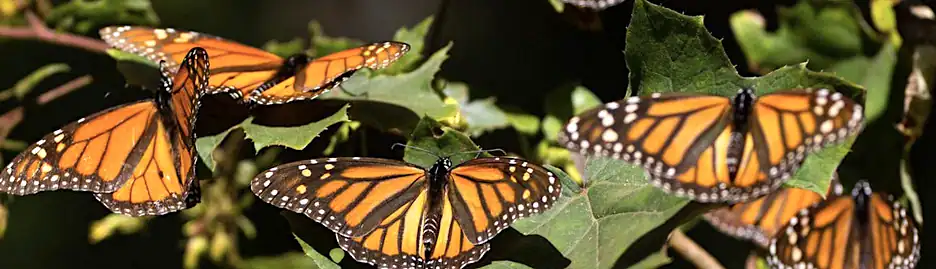
(A reminder about the April 6 Cockrell Butterfly Center plant sale. While you’re at the Museum of Natural Science, do take in the “Flight of the Butterflies” 3-D movie at the Wortham Giant Screen Theater. (STILL PLAYING!) This should be a must-see for the young and the young-at-heart.
I had the great fortune to go on one of the Cockrell’s trips to the Michoacan, Mexico, monarch wintering sites. This movie tells it exactly as it is. And the 3-D has butterflies literally flying all around you, an incredible experience.
More importantly, however, the film emphasizes how important it is for us home gardeners to help replace increasingly disappearing “habitat highways” and to support efforts to help save this irreplaceable natural treasure site. Check out the threats on Texas Monarch Watch:http://www.texasento.net/dplex.htm.
* * *
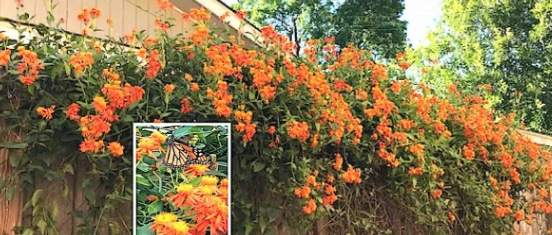
Reader Margie wrote: “My husband (while I was gone) cut back my coral vine that had grown wild over our fence. He hated all those dead brown tendrils, but It already had a lot of new green growth on it. Did he kill it?”
I doubt it very seriously. We had a similar situation in our yard. Coral vines (like many other super-hardy vines) may have had top dieback, but be assured the roots continued to grow all through our winter-that-wasn’t. All that dead growth is best removed so you can route the new sprouting vines exactly where you want them to go.
Now is, by the way, a great time to plant vines. They need a little cold to get their roots going strong before the hot summer sun starts baking our gardens. In shade, try bleeding heart vine (Rangoon creeper); it loves bright shade areas. For hot, sun-baked areas, it’s hard to beat Mexican flame vine.
* * *

ATTN:
— Nature’s Way Resources offers free guided tours of NWR’s extensive nursery/soil/mulch facilities for garden clubs, plant societies and other plant-oriented, organized groups. As usual, NWR’s now-expanded meeting site is free to above groups. Reservations a must for both. Great time to visit.
- GOOD NEWS FOR BUSY/LAZY GARDENERS: Curbside pickup is now available in the Nature’s Way Resources nursery, and we’re offering plant preorders for special requests. Call in your order, pick it up when it works for you, or let us try to source the plants you’re looking for on upcoming shipments. Find inventory sheet here.
Want to receive The Lazy Gardener & Friends weekly newsletter?
John’s Corner
NEWS FROM THE WONDERFUL WORLD OF SOIL AND PLANTS
EDITORS’ NOTE:
Please note that this article has been condensed from its original publishing for clarity and ease of reading.
Earthworms: A Gardener’s Best Friend
by John Ferguson,
Founder of Nature’s Way Resources
Earthworms are one of nature’s most important soil builders. Their tunneling activity improves soil structure, aeration, porosity, permeability, and drainage while reducing runoff and erosion. Research has shown that soils rich in earthworms can absorb water dramatically faster than soils without them, with some studies reporting infiltration rates up to 35 times greater. In healthy soils, earthworm burrows can account for a major portion of the soil’s air-filled pore space, helping roots penetrate deeper into the soil profile.
Earthworm castings are biologically active and richer in nutrients than surrounding soil, often containing higher levels of calcium, nitrogen, phosphorus, potassium, and magnesium. Their castings also improve the soil’s ability to absorb and retain moisture. Studies from the Bhawalker Earthworm Research Institute found that castings absorb water faster than soil and can even pull moisture from the air in forms plants can utilize.
As earthworms process organic matter, they stimulate beneficial microbial activity throughout the soil. Research has shown bacterial and actinomycete populations near burrows and castings can be 10–1,000 times greater than surrounding soil. Nitrogen-fixing bacteria also thrive in worm-rich soils, helping naturally improve fertility. The earthworm gut acts as a biological reactor that increases microbial density and helps break down organic residues and certain harmful compounds.
Earthworms also help make nutrients more available to plants through chelation and mineral cycling. By bringing minerals up from deeper soil layers and depositing them near the surface as castings, worms help counteract nutrient leaching. Their abandoned burrows become fertile root channels lined with nutrient-rich mucus and plant growth-promoting compounds such as auxins, encouraging deeper and healthier root development.
Research has consistently linked earthworm activity with increased plant growth and crop yields. Studies have reported yield increases ranging from 25% to several hundred percent in worm-rich soils. Vermicompost has also been shown to improve seed germination, root growth, and overall plant vigor, even when added at relatively low rates to potting media.
A healthy earthworm population is one of the best indicators of healthy soil.
Organic mulches, compost applications, reduced tillage, and avoiding synthetic fertilizers and pesticides all help encourage earthworm populations. In return, earthworms provide continuous natural soil improvement, fertility enhancement, drainage, and biological activity, functioning as a living underground workforce that supports long-term soil health.
Download the Original Newsletter Issue Below!
Sponsorship
If you are interested in becoming a sponsor, please contact us at 936-273-1200 or send an e-mail to: lazygardenerandfriends@gmail.com
About Us
BRENDA BEUST SMITH
WE KNOW HER BEST AS THE LAZY GARDENER . . .
but Brenda Beust Smith is also:
- a national award-winning writer & editor
- a nationally-published writer & photographer
- a national horticultural speaker
- a former Houston Chronicle reporter
When the Chronicle discontinued Brenda’s 45-year-old Lazy Gardener” print column — started in the early ’70s as a fun side-project to reporting, it then ranked as the longestrunning, continuously-published local newspaper column in the Greater Houston area. The name, she says, is not just fun, it’s true.
Brenda’s gradual sideways step from reporter into gardening writing led first to an 18-year series of when-to-do-what Lazy Gardener Calendars, then to her Lazy Gardener’s Guide book which morphed into her Lazy Gardener’s Guide on CD, which she now emails free upon request.
Brenda became a Harris County Master Gardener and, over the years, served on theboards of many Greater Houston area horticulture organizations. She hosted local radio and TV shows, most notably a 10+-year Lazy Gardener specialty shows on HoustonPBS (Ch. 8) and her call-in “EcoGardening” show on KPFT-FM.
For over three decades, Brenda served as Assistant Production Manager of the GARDEN CLUB OF AMERICA’S “BULLETIN” magazine. Although still an active broad-based freelance writer, Brenda’s main focus now is THE LAZY GARDENER & FRIENDS HOUSTON GARDEN NEWSLETTER with John Ferguson and Pablo Hernandez of Nature’s Way Resources.
A native of New Orleans and graduate of St. Agnes Academy and the University of Houston, Brenda lives in Humble, TX, and is married to the retired Aldine High School Coach Bill Smith. They have one son, Blake.
Regarding this newsletter, Brenda is the lead writer, originator of it and the daily inspiration for it. We so appreciate the way she has made gardening such a fun way to celebrate life together for such a long time.
About her column, Brenda says: “I don’t consider myself a ‘garden writer.” I started out 50+ years ago as a very lazy “gardening reporter.” I still feel that way today. I hope my columns inspire/help newcomers, but I do not write to them. I write to very experienced gardeners who want to expand their horizons.
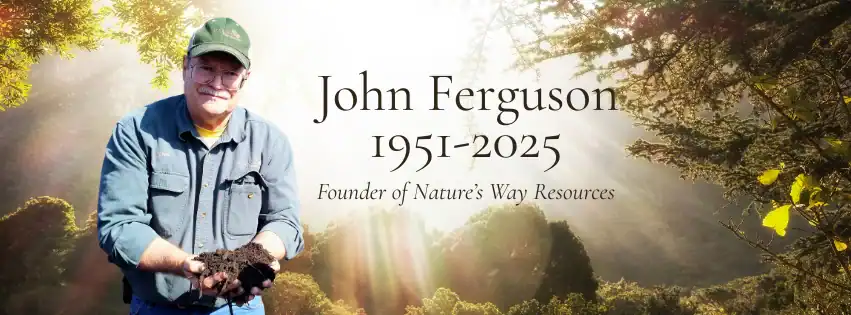
JOHN FERGUSON (1951-2025)
John was a native Houstonian with more than 35 years of business experience. He founded Nature’s Way Resources, a composting company known for producing high-quality compost, mulch, and soil mixes. He held an MS in Physics and Geology and was a licensed Soil Scientist in Texas.
Throughout his career, John received numerous awards in horticulture and environmental work. He represented the composting industry for many years on the Houston-Galveston Area Council for solid waste. His personal garden was featured in several horticultural books and in Better Homes and Gardens. His business was recognized by The Wall Street Journal for the quality and value of its products. He was a member of the Physics Honor Society and several professional organizations, and he co-authored Organic Management for the Professional.
John contributed articles regularly to this newsletter and oversaw its publication. We continue to share his past articles each week alongside The Lazy Gardener column to keep his passion, knowledge, and spirit alive for our readers.
SHELBY CASSANO is the communications and marketing lead for Nature’s Way Resources and the editor of The Lazy Gardener and Friends newsletter. Through her business, Leaf and Ledger, she exclusively partners with NWR to direct all marketing efforts, from campaign strategy and content planning to technical production of the newsletter. Shelby holds a B.S. in Agriculture with a concentration in Horticulture from Stephen F. Austin State University and previously managed the company’s nursery.

NATURE’S WAY RESOURCES
101 Sherbrook Cir.
Conroe, TX 77385
Hours of Operation
Monday – Friday: 8AM to 5PM
Saturday: 8AM to 2PM
Copyright © 2024 Nature’s Way Resources | All rights reserved.