
Nature’s Way Resources is proud to bring you this free weekly newsletter. While we don’t run ads, generous sponsors help support this project as a public service. Their names are listed below, please consider showing your appreciation by supporting their businesses!
Nature’s Way Resources honors the contributions of our late owner, John Ferguson. “The Lazy Gardener” Brenda Beust Smith and Shelby Cassano welcome your feedback and remain grateful to the many horticulturists who share their expertise.
Published April 7, 2026

by Brenda Beust Smith | The Lazy Gardener
HARD TO BELIEVE it’s May already!!! Love a line just saw on the ‘net: “May is the last warm season month in Houston.”
Newcomers, pay heed! From this point on, optimum word will not be “warm,” but “HOT”!
While most of the nation is still in ‘spring’ mode, our plants (floral and edibles) are grinning with delight! Get those stakes out next to edibles that need them. Growing will be fast this month.
Best tip I ever got: When plant shopping and you’re faced with an enormous number of varied, gorgeous flowers in spring displays, step back!
Study colors, shapes, etc., carefully, on the tables filled with spectacular flowers everywhere. BUT . . .
DON’T BUY those that first draw your eye! Instead, make a note of the ones you like. Include a star over those that really make your eyes pop. Mark its aisle (1, 2, etc.). Then wheel your cart up and down all the aisles.
Once you decide how many you can afford (often the worst part), start over at the same beginning aisle. Some will look sad next to others you saw further down. Some will grab your heart. Must buy, but don’t just “grab”. Use those gorgeous flowers to find them again. BUT . . . Buy those covered with budding seeds, not massive flowers.
Flowers in bloom will quickly fade. Select instead, plants with strong, healthy stalks and leaves. Then, among those, look for barely-starting buds. This will give the plant more time to adjust to the change of environment and set roots.
When you put those plants in, you want their first instincts to be setting strong roots, not producing usually artificially forced flowers that will sap strength from the also developing roots!
THINK YOUR PLANTS GOT ENOUGH WATER LAST WEEK?
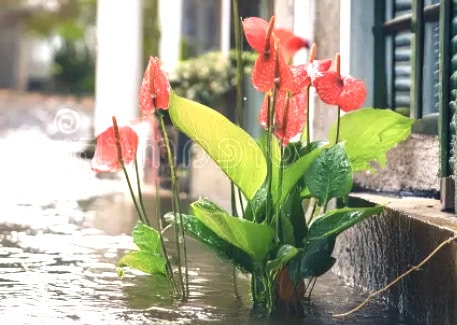
After our recent deluges (and future ones predicted), the vast majority of us don’t need to worry about watering! Perfect time to allot parts of the garden to the kiddos. With the deep watering we just got, encourage kids to sow flower seeds or vegetables they like, and plant them (or seeds). Your neighborhood independent nurseries will have the vegetable and decorative plants that do well in your area. Seeds are fun, but might throw in some already-started plants, an encouragement to children who — let’s face it — expect INSTANT gratification!
* * *
SPEAKING OF RECENT RAINS, too much watering can be as bad as not enough. Overwatering symptoms may appear slowly, affecting one plant one way and another differently. Some take longer to display symptoms. Wilting and yellowing leaves are common early signs. Also leaves falling off and abnormal, maybe stunted, growth. What to do?
First, don’t water! Then, without disturbing the roots, try to loosen the soil (gently poking holes will help evaporation and better absorption). Restore vining plants to their former places. Staking branches upright may help plants regain their former form.
With potted plants, of course, remove damaged leaves and water from saucers. Might think about moving them out of bright sunlight for a couple of days. Don’t stomp around wet soil. You’ll just pack it down, squishing out oxygen.
* * *
Plumerias safe at home in heavy
rains in the Sanchez garden!
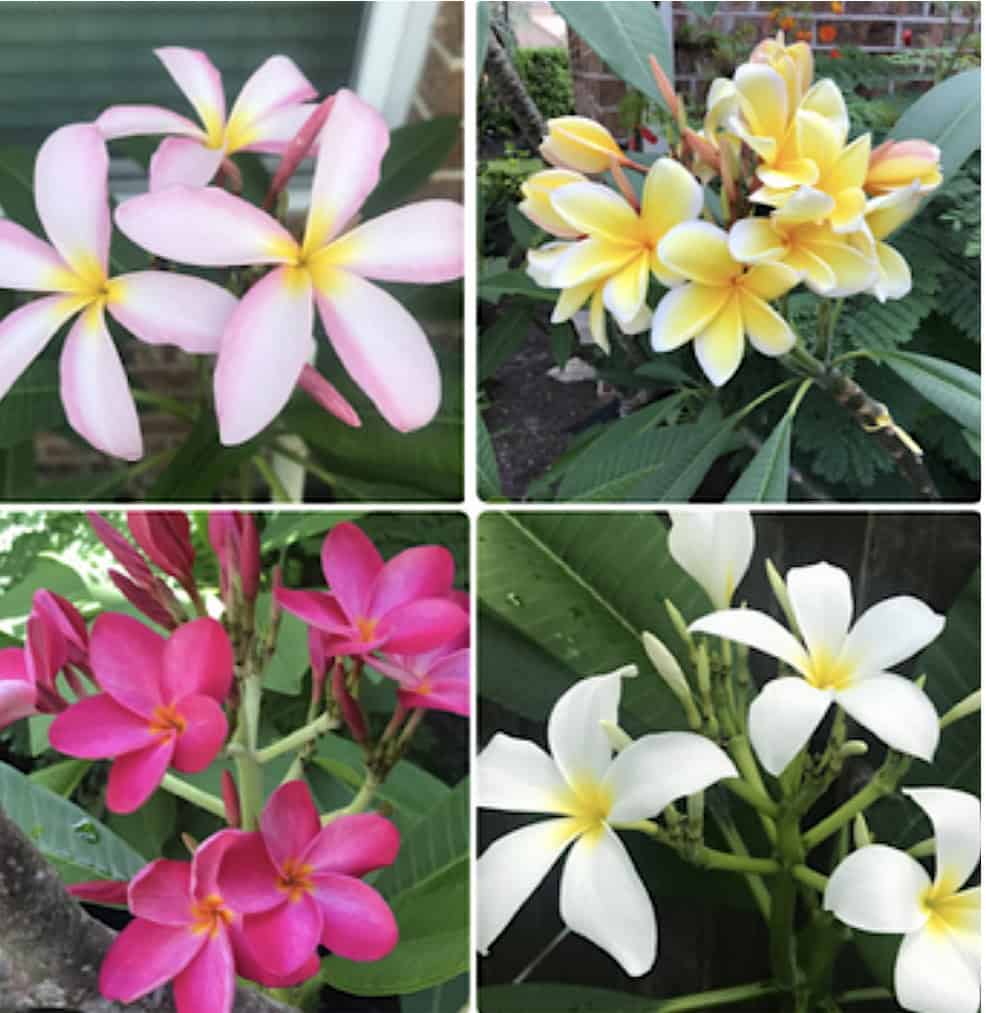
Upper left: “Red Rose’; top right: ‘Lemon Chiffon’; bottom left: ‘Rose Red’; and bottom right: ‘White Cluster’.
A reader asked (a little late!) about plumerias in heavy rain, so I turned to my cousin in League City, Sharon Beust Sanchez (whose yard overflows with so many plumerias – including these above), she’s started selling them!
Most important now, Sharon says, is to “put them in the sun and don’t let them get wet feet. They will rot from the inside out!”
Sharon and husband Ernie don’t “plant” their plumerias. They “pot” them first, then dig a hole 2/3-3/4 deep and bury the pots & all. Altho they lift them in very heavy rains, those plants-in-pots go back in the ground as soon as possible. Makes moving them so much easier, especially when moving their “hundreds” of these delights inside in winter or when heavy storms threaten.
NOTE: The Sanchezs are happy to answer your plumeria questions and help readers identify plants. Sharon doesn’t mind calls and can be reached at 409-795-0017.
* * *
SPEAKING OF HEAT-LOVING PLANTS . . .
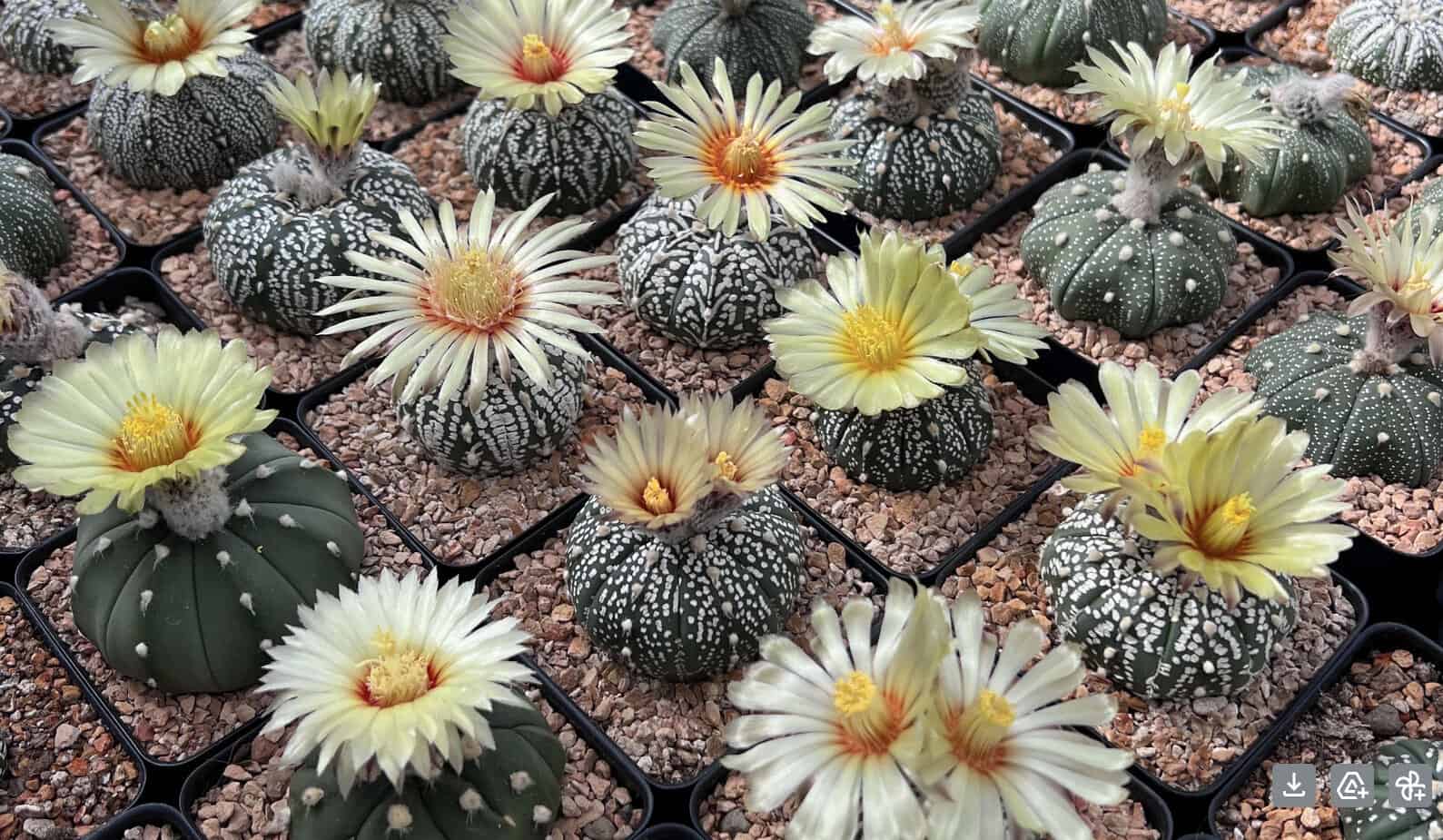
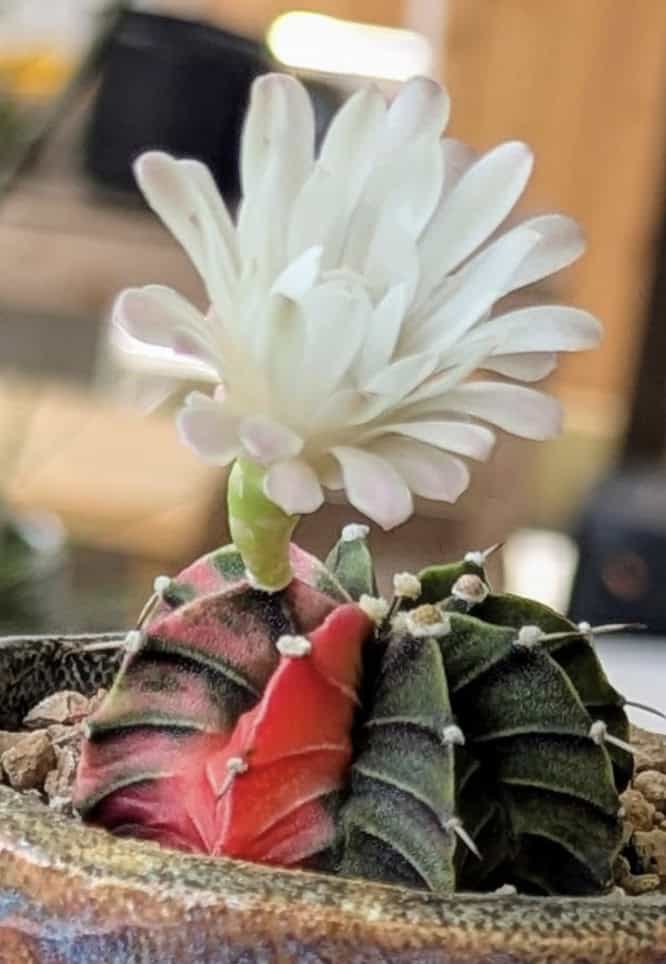
- GIVEN OUR HEAT PREDICTIONS AT COLUMN TOP, thought folks might be particularly interested in planting more cacti and succulents, (such as pictured Astrophytum asterias (at top) and Gymnocalycium mihanovichii (bottom)) that will be among the array available at the Houston Cactus and Succulent Society’s rapidly approaching sale:
* * *

ATTN:
— Nature’s Way Resources offers free guided tours of NWR’s extensive nursery/soil/mulch facilities for garden clubs, plant societies and other plant-oriented, organized groups. As usual, NWR’s now-expanded meeting site is free to above groups. Reservations a must for both. Great time to visit.
- GOOD NEWS FOR BUSY/LAZY GARDENERS: Curbside pickup is now available in the Nature’s Way Resources nursery, and we’re offering plant preorders for special requests. Call in your order, pick it up when it works for you, or let us try to source the plants you’re looking for on upcoming shipments. Find inventory sheet here.
Want to receive The Lazy Gardener & Friends weekly newsletter?
John’s Corner
NEWS FROM THE WONDERFUL WORLD OF SOIL AND PLANTS
EDITORS’ NOTE:
Today, we are exploring elements 48-55 on the periodic table and what they do for your health. Often, we dismiss or take for granted the minerals that go into our bodies, or those that don’t. We thought we would shed some light on a few, not-so-thought-of elements with a past article by John from 1/14/22.
Please note that this article has been condensed from its original publishing for clarity and ease of reading.
MINERALS – The Elements and What They Do
by John Ferguson,
Founder of Nature’s Way Resources
Today, we continue our look at elements 48–55 on the periodic table and their roles in human health, soil, and gardening: cadmium, indium, tin, antimony, tellurium, iodine, xenon, and cesium.
Cadmium (Cd) is a toxic heavy metal found naturally in rocks, coal, and some fertilizers. It accumulates in soils, plants, and animal tissues, especially kidneys. Cadmium mimics zinc in the body and can interfere with DNA repair, mitochondrial activity, and enzyme function. Excess exposure has been linked to cancer and many degenerative diseases. Artificial fertilizers, sewage sludge, coal ash, and black mulch products can increase cadmium levels in soils. Some vegetables, mushrooms, and tobacco readily absorb cadmium, especially in acidic or salty soils.
Indium (In) is widely used in electronics, touch screens, and LCD displays. While it has no known biological role in humans, small amounts can stimulate metabolism, but larger amounts may damage the kidneys, liver, and heart. In soils, indium can inhibit nitrogen-fixing bacteria at elevated levels and is associated with sewage sludge contamination.
Tin (Sn) has been used for over 5,000 years in bronze, solder, food cans, and electronics. Tin is considered an essential trace element in small amounts, but too much can interfere with zinc absorption and damage the liver and nervous system. Tin tends to accumulate in plant roots and organic-rich soils. Coal ash and industrial contamination are common sources.
Antimony (Sb), a metalloid often associated with lead and arsenic, is used in batteries, flame-resistant products, and semiconductors. Historically, antimony poisoning has been linked to health issues dating back to ancient Rome. While plants readily absorb antimony, toxicity is usually only seen at very high concentrations. Coal, sewage sludge, and smelters are major contamination sources.
Tellurium (Te) is a rare semi-metal used in electronics, Blu-ray players, glass, and oil refining. Some tellurium compounds may have antioxidant and anti-tumor properties. Plants absorb tellurium easily, with onions and garlic naturally accumulating higher levels. Coal ash and smelters are the primary environmental sources.
Iodine (I) is essential for human health, especially thyroid function, metabolism, brain development, and immune support. Deficiencies are widespread worldwide and linked to goiter, fatigue, reduced IQ, developmental issues, and increased cancer risk. Fluoride, bromine, nitrates, and some pollutants can interfere with iodine absorption. Organically grown foods, seaweed, seafood, eggs, and grass-fed dairy are important iodine sources. Healthy soils rich in organic matter help support iodine availability to plants.
Xenon (Xe) is a rare noble gas used in specialty lighting, flash bulbs, and spacecraft propulsion. It appears to have little biological significance, though studies suggest it may have anesthetic properties. Xenon does not significantly affect plant growth.
Cesium (Cs) is a highly reactive metal used in atomic clocks and oil drilling. While it is not required by plants, some species can accumulate cesium from soils, making them useful for phytoremediation. Coal ash and radioactive fallout are common environmental sources.
John’s overall takeaway: many heavy metals and trace elements become concentrated through artificial fertilizers, sewage sludge, coal ash, and industrial pollution. Building healthy organic soils with quality compost and organic fertilizers helps reduce harmful uptake while improving plant and human health.
Download the Original Newsletter Issue Below!
Sponsorship
If you are interested in becoming a sponsor, please contact us at 936-273-1200 or send an e-mail to: lazygardenerandfriends@gmail.com
About Us
BRENDA BEUST SMITH
WE KNOW HER BEST AS THE LAZY GARDENER . . .
but Brenda Beust Smith is also:
- a national award-winning writer & editor
- a nationally-published writer & photographer
- a national horticultural speaker
- a former Houston Chronicle reporter
When the Chronicle discontinued Brenda’s 45-year-old Lazy Gardener” print column — started in the early ’70s as a fun side-project to reporting, it then ranked as the longestrunning, continuously-published local newspaper column in the Greater Houston area. The name, she says, is not just fun, it’s true.
Brenda’s gradual sideways step from reporter into gardening writing led first to an 18-year series of when-to-do-what Lazy Gardener Calendars, then to her Lazy Gardener’s Guide book which morphed into her Lazy Gardener’s Guide on CD, which she now emails free upon request.
Brenda became a Harris County Master Gardener and, over the years, served on theboards of many Greater Houston area horticulture organizations. She hosted local radio and TV shows, most notably a 10+-year Lazy Gardener specialty shows on HoustonPBS (Ch. 8) and her call-in “EcoGardening” show on KPFT-FM.
For over three decades, Brenda served as Assistant Production Manager of the GARDEN CLUB OF AMERICA’S “BULLETIN” magazine. Although still an active broad-based freelance writer, Brenda’s main focus now is THE LAZY GARDENER & FRIENDS HOUSTON GARDEN NEWSLETTER with John Ferguson and Pablo Hernandez of Nature’s Way Resources.
A native of New Orleans and graduate of St. Agnes Academy and the University of Houston, Brenda lives in Humble, TX, and is married to the retired Aldine High School Coach Bill Smith. They have one son, Blake.
Regarding this newsletter, Brenda is the lead writer, originator of it and the daily inspiration for it. We so appreciate the way she has made gardening such a fun way to celebrate life together for such a long time.
About her column, Brenda says: “I don’t consider myself a ‘garden writer.” I started out 50+ years ago as a very lazy “gardening reporter.” I still feel that way today. I hope my columns inspire/help newcomers, but I do not write to them. I write to very experienced gardeners who want to expand their horizons.
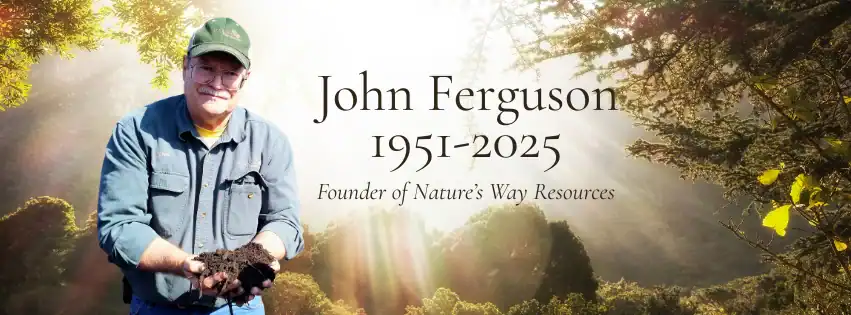
JOHN FERGUSON (1951-2025)
John was a native Houstonian with more than 35 years of business experience. He founded Nature’s Way Resources, a composting company known for producing high-quality compost, mulch, and soil mixes. He held an MS in Physics and Geology and was a licensed Soil Scientist in Texas.
Throughout his career, John received numerous awards in horticulture and environmental work. He represented the composting industry for many years on the Houston-Galveston Area Council for solid waste. His personal garden was featured in several horticultural books and in Better Homes and Gardens. His business was recognized by The Wall Street Journal for the quality and value of its products. He was a member of the Physics Honor Society and several professional organizations, and he co-authored Organic Management for the Professional.
John contributed articles regularly to this newsletter and oversaw its publication. We continue to share his past articles each week alongside The Lazy Gardener column to keep his passion, knowledge, and spirit alive for our readers.
SHELBY CASSANO is the communications and marketing lead for Nature’s Way Resources and the editor of The Lazy Gardener and Friends newsletter. Through her business, Leaf and Ledger, she exclusively partners with NWR to direct all marketing efforts, from campaign strategy and content planning to technical production of the newsletter. Shelby holds a B.S. in Agriculture with a concentration in Horticulture from Stephen F. Austin State University and previously managed the company’s nursery.

NATURE’S WAY RESOURCES
101 Sherbrook Cir.
Conroe, TX 77385
Hours of Operation
Monday – Friday: 8AM to 5PM
Saturday: 8AM to 2PM
Copyright © 2024 Nature’s Way Resources | All rights reserved.