
Nature’s Way Resources is proud to bring you this free weekly newsletter. While we don’t run ads, generous sponsors help support this project as a public service. Their names are listed below, please consider showing your appreciation by supporting their businesses!
Nature’s Way Resources honors the contributions of our late owner, John Ferguson. “The Lazy Gardener” Brenda Beust Smith and Shelby Cassano welcome your feedback and remain grateful to the many horticulturists who share their expertise.
Published April 29, 2026
by Brenda Beust Smith | The Lazy Gardener
I love the way Houston Hemerocallis (Daylily) Society is directly appealing to gardeners with their SAT., MAY 9: show/sale “MENU”!
You have to hand it to our “specific flower”-oriented societies. Our demand is so great for “NEW!!!!” plants, it takes “5th Avenue Advertising” talent these days to really “draw our attention”! (Fortunately, plenty of that here in Greater Houston area.)
Hats off to MILTON PIERSON and our HOUSTON HEMEROCALLIS (DAYLILY) SOCIETY for their unique approach to their SAT., MAY 9, ANNUAL FLOWER SHOW AND DAYLILY PLANT SALE, (Sale: 8am-3pm; Show 1-3pm, Gethsemane Lutheran Church, 4040 Watonga Dr., Free, www.ofts.com/hhs/). And — thanks, Milton — for this advance “peek” below at your online “MENU”!
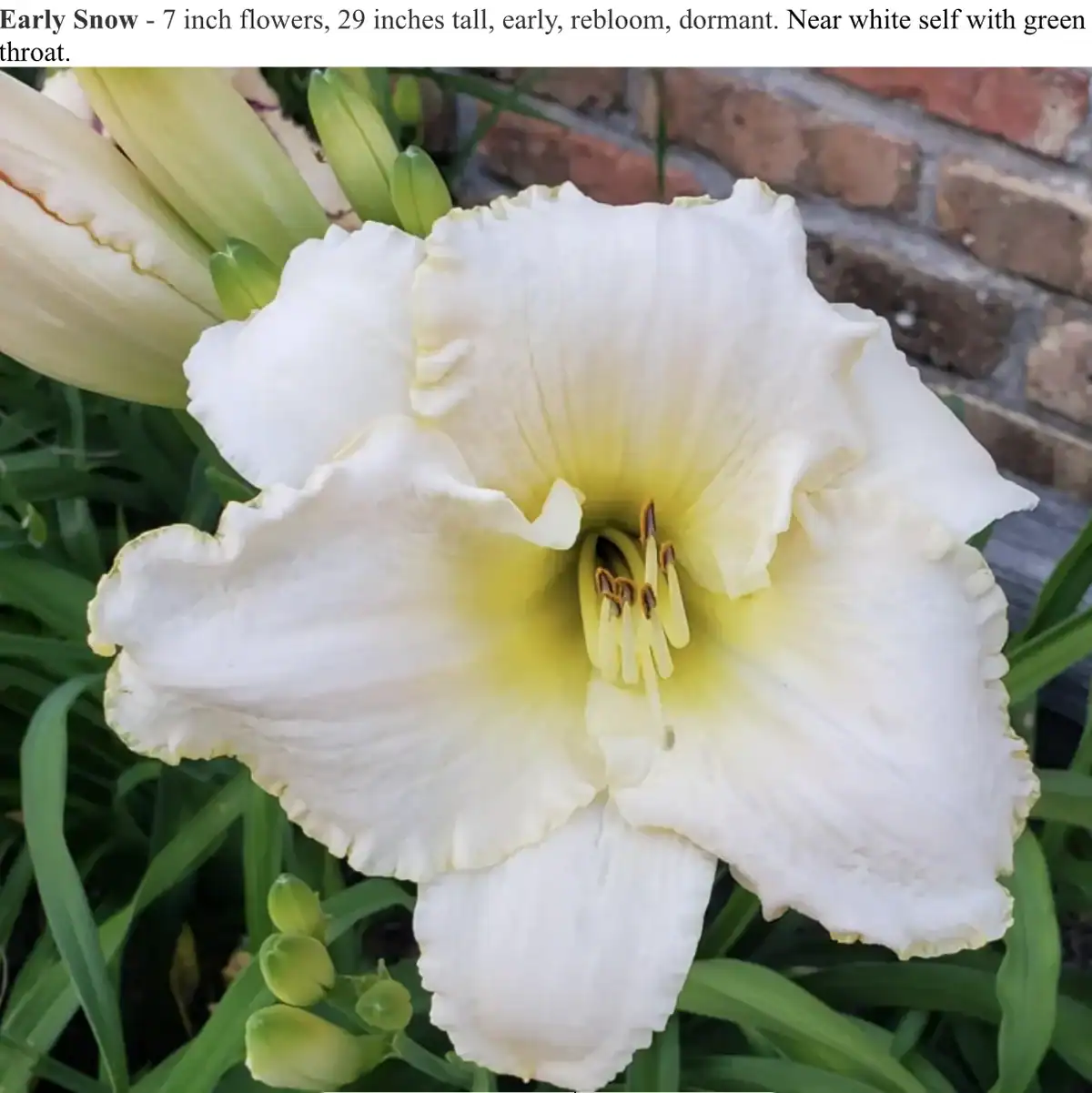
Looking for near white or very pale colored flowers? Among these, be sure to check out: ‘EARLY SNOW ‘- 7’ flowers, 29″ tall, early, rebloom, dormant. Near white self with green throat.
* * *
PS. Just before I finished this column, someone sent me a note saying she heard it’s now ok to plant tomatoes by roses. She’d always heard NOT a good idea! Glad had expert handy. Loved Angela’s response!
“I would rate this as no big deal either way. There are some people who believe that tomatoes have a protective effect, which is not backed up by science. There are others that claim they are competitors, which is also not backed up.
“They are both heavy feeders, but that is more an issue of the gardener providing adequate nutrition, so I discount that concern. They can share powdery mildew, but that is not a huge concern either since many modern cultivars are resistant.”
Check out Angela’s Spotlight Article below for more on companion plantings for roses
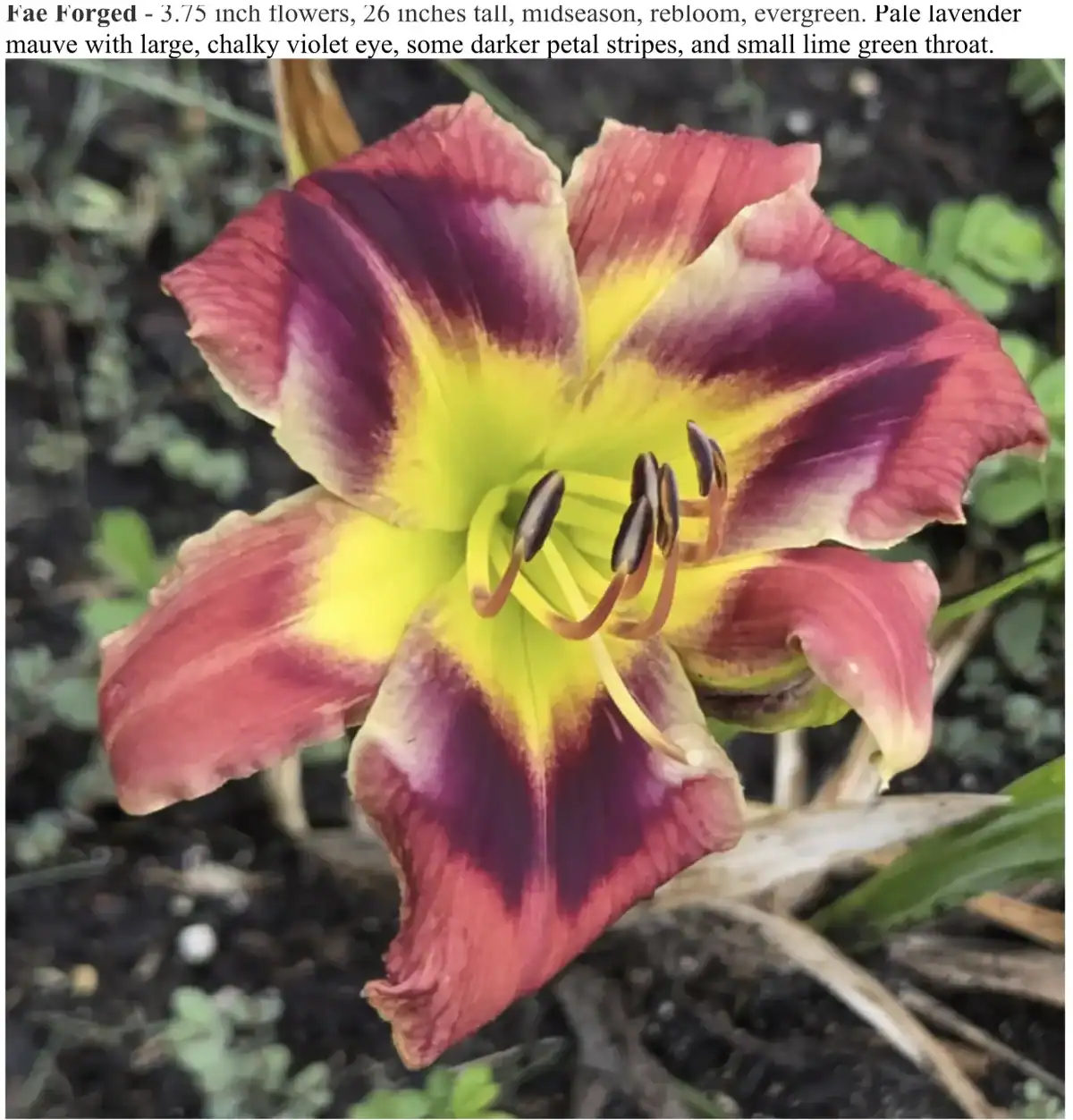
SEVERAL FIT THIS BILL, including: ‘FAE FORGED‘ – 3.75’ flowers, 26″ tall, midseason, rebloom, evergreen. Pale lavender mauve with large, chalky violet eye, some darker petal stripes, and small lime green throat.
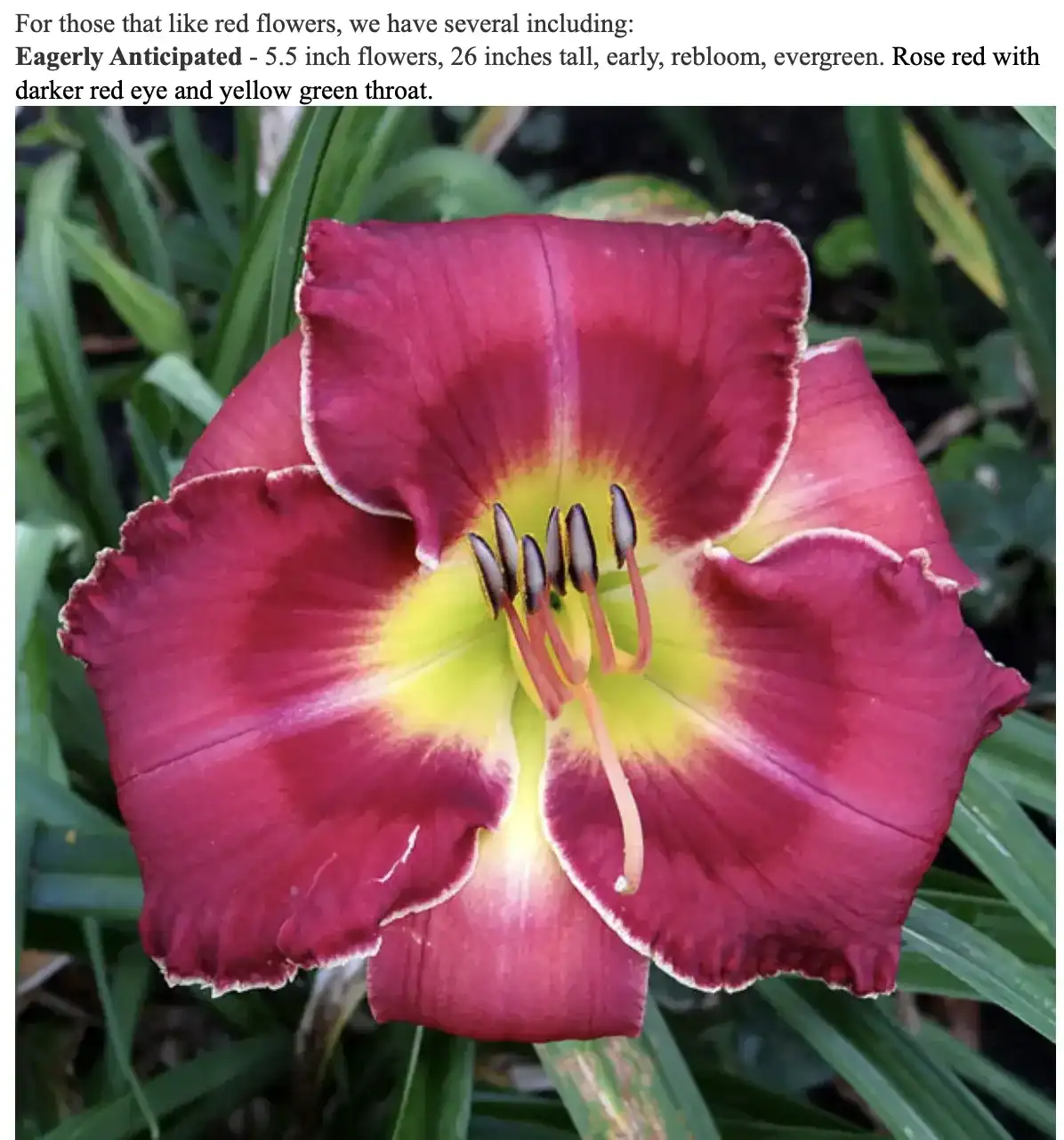
‘EAGERLY ANTICIPATED’ — Like flowers with interesting patterns and bold eye? 5.5-inch flowers, 26 inches tall, early, rebloom, evergreen. Rose red with darker red eye and a yellow-green throat. For those that like red flowers, we have several.
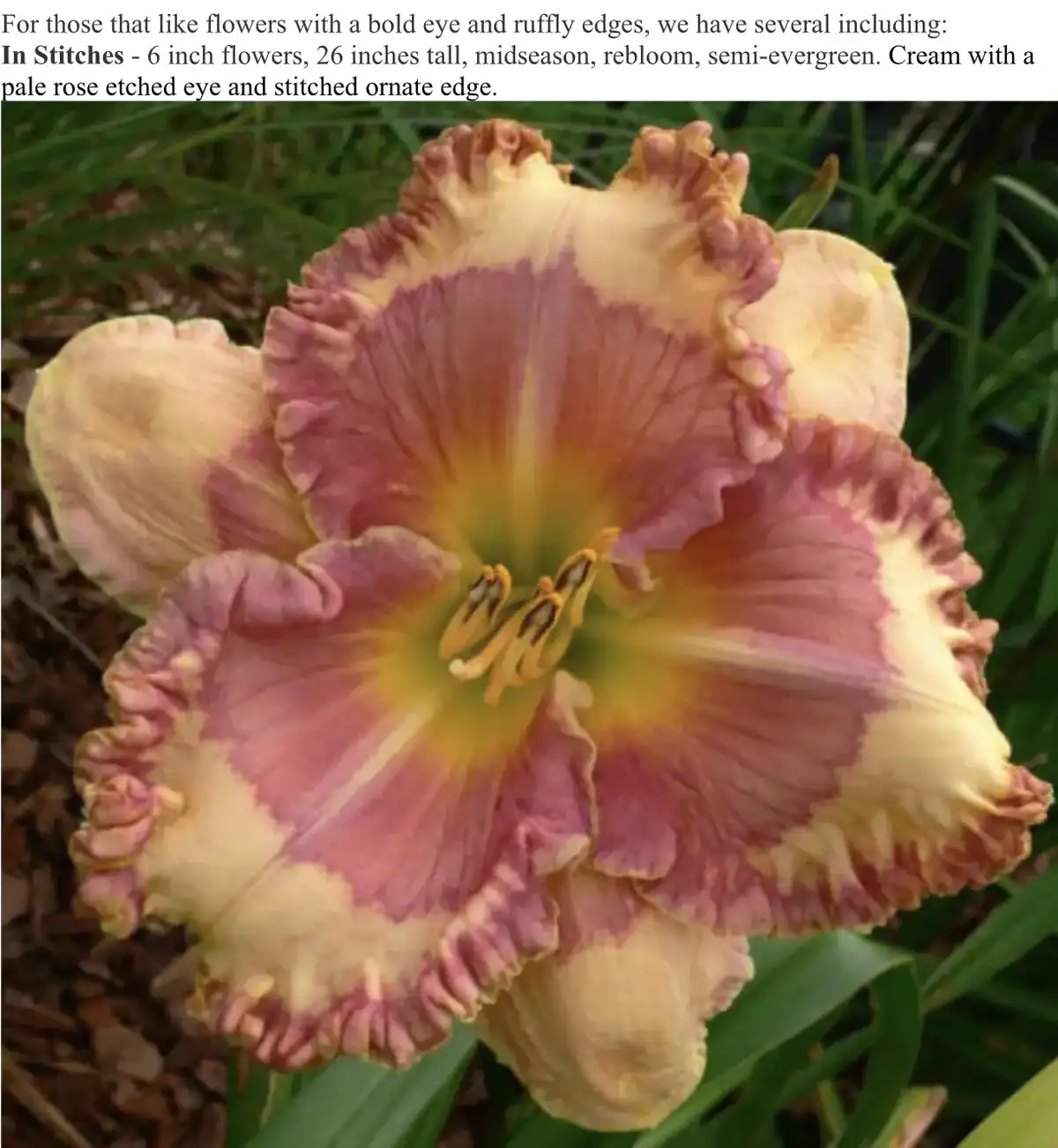
- For those who like flowers with a bold eye and ruffly edges, several including ‘IN STITCHES’ — 6″ fowers, 26″ tall, midseason, rebloom, semi-evergreen. Cream with a pale rose etched eye and stitched ornate edge.
Before more on daylilies, I’d like to add that from very beginning of the Lazy Gardener column (somewhere in late 60’s or early 70’s, assigned to a totally non-gardening Chronicle reporter until a REAL gardener could be found. HA!), I have steadily maintained that the daylily is, without doubt, the easiest, most polite of flowers to grow here. Definitely a must for “lazy gardeners.” But, back to the experts:
* * *

SOME THINGS YOU MIGHT NOT
KNOW ABOUT DAYLILIES
Condensed from handout by Milton Pierson and
- Daylily flowers typically bloom for one day, opens in morning, wilts by evening, quickly replaced by new buds. Blooming period for daylilies can last weeks to months.
- Deadheading single (only) spent flowers for more blooms; single flower stem can produce multiple blooms. (Removing single spent blooms from stem conserves energy to encourage more blooms). Cutting at base of a blooms as soon as it dies helps plants produce many more flowers.
- Removing seed pods also encourages more blooming. But you can actually make the daylilies bloom more by removing the seed pods. Many people choose to leave at least a few of them alone so that they’ll have seeds to utilize later on.
- If your goal is simply to extend the blooming season, you’ll be better off removing the seed pods. When you go to cut the spent bloom, do so at the base.If you cut too high, you’ll leave the seed pod on the plant.
- —
- These are just tip of the iceberg when it comes to information you can pick up at the SAT., MAY 9: HOUSTON HEMEROCALLIS (DAYLILY) SOCIETY ANNUAL FLOWER SHOW AND DAYLILY PLANT SALE, Sale: 8am-3pm; Show 1-3pm, Gethsemane Lutheran Church, 4040 Watonga Dr., Free, www.ofts.com/hhs/
- WEBSITE for advanced views of daylilies in show/or for sale https://www.reflectionscarlson.com/hhs-2026-daylilies.html)
* * *

Helianthus annuus in suburban business area
PLANNING CELEBRATIONS THIS WEEKEND? Sunday, May 1, is Sunflower Guerrilla Gardening Day. GUERILLA? Yep. The year was 2007. In Brussels (capital of Belgium, a group of gardeners decided to beautify their urban homeland, especially, as we know well, vacant lots can become very neglected. (Often — without asking property owners — they would sneak on lots spreading sunflower seeds.) Apparently, the seeds grew and bloomed among the weeds, to the delight of many, tho probably not all.
They chose Helianthus annuus (our most common, highly visible sunflower), which, as they hoped, would draw attention (some bad, but mainly very successfully). Helianthus annuus is the same as our most prominent, low-cost, and “hugely visible” for photography. With success came organization (GuerrillaGardening.org), a global following, “Sunflower Guerilla Gardening Day,” and followers across the globe. (Gardenista and Daniel Boone Regional Library.)
The movement encourages planting sunflowers on May 1—or early May—to ensure they bloom in summer, transforming neglected spaces into bright, attractive spots.
(Author’s note: Just reporting, NOT advising you to do this, ok? OK?)
* * *

ATTN:
— Nature’s Way Resources offers free guided tours of NWR’s extensive nursery/soil/mulch facilities for garden clubs, plant societies and other plant-oriented, organized groups. As usual, NWR’s now-expanded meeting site is free to above groups. Reservations a must for both. Great time to visit.
- GOOD NEWS FOR BUSY/LAZY GARDENERS: Curbside pickup is now available in the Nature’s Way Resources nursery, and we’re offering plant preorders for special requests. Call in your order, pick it up when it works for you, or let us try to source the plants you’re looking for on upcoming shipments. Find inventory sheet here.
Want to receive The Lazy Gardener & Friends weekly newsletter?
John’s Corner
NEWS FROM THE WONDERFUL WORLD OF SOIL AND PLANTS
EDITORS’ NOTE:
This is the last installation of “What is a Healthy Soil” by John Ferguson. John was an original pioneer of “organic gardening” in a widely conventional world back in the 90’s.
Thank you for reading along.
What Is A Healthy Soil – Part 7 (continued)
by John Ferguson,
Founder of Nature’s Way Resources
When we use dangerous synthetic chemicals in our gardening, we create most of our own problems. It is like a bunch of dominoes going down.
Turf grass Example: It starts when we use a synthetic fertilizer on our lawns in spring. The salts present kill off good bacteria that control fungal diseases and earthworms, which results in soil compaction and poor drainage. Without the good bacterium, fungal problems like brown patch develop. We are told to treat brown patch with a broad-spectrum fungicide like terraclor, which kills all fungi in the soil (This is analogous to going to a Texan’s game with 80,000 fans in the stadium and killing everyone to get the one criminal).
This does several things, as it also kills beneficial fungus living in the soil, like the endophytic fungus, which lives in a symbiotic relationship with grass roots. This good fungus receives food from the grass and, in return, produces toxins that repel/kill chinch bugs and sod webworms. The fungicide also kills the good fungus that breaks down dead grass, so we get a buildup of thatch as the weather warms up. This thatch layer makes a good home for chinch bugs (or webworms) since the fungus that repels and kills them is gone.
Chemical companies tell us to apply Diazinon or other pesticides to control chinch bugs. Pesticides kill the earthworms and microarthropods that aerate soil, preventing compaction. Earthworms also eat weed seeds, destroying them. Air (oxygen) can no longer get into the soil, hence root growth is very shallow. This requires us to water several times a week, as the soil cannot hold much water, and there is very little root zone for the grass to draw water from.
Note: This excessive watering leaches nutrients from our soils that pollute our bayous and streams, and eventually leads to the dead zone in the Gulf of Mexico. Now we have to apply the artificial fertilizer 3-4 times per year to replace what was lost. Additionally, the chlorine (Cl) in our public water systems, in combination with the sodium (Na) in our soils, forms sodium chloride, which is known as table salt. This additional salt aggravates the problems a gardener experiences.
We are now told that we need to do a core aeration to break up the compaction and help air and water move into the soil since we no longer have the earthworms and other soil life doing that for us. Many of the plant species we call weeds are designed to grow on compacted and chemically out-of-balance soils. So, without the earthworms and other soil life, we have created a condition that favors weeds. The salts from the artificial fertilizer can cause a calcium (Ca) tie-up in the soil.
For weeds like Dandelions to germinate and grow, they require soils with low available calcium and low oxygen (compaction) hence, we have created conditions that favor weeds over turf grass. Now we are told we need to use an herbicide or a weed and feed fertilizer since we have weeds.
The above scenario is very easy to avoid. One just needs to use an organic fertilizer instead of an artificial one. My favorite organic fertilizer is called MicroLife, which I use for everything from house plants to fruit trees and turf grass. Next, apply a compost top dressing to the lawn to build organic matter and inoculate the soil with beneficial microbes.
Note: Cheap, low-quality compost does not work well, and some may actually kill turf. During the 1980’s, when the composting industry was getting started, a massive amount of research was conducted by the EPA, USDA, and many universities. They found to have high quality compost there had to be a little manure used in producing it.
I enjoy the exercise I get from spreading compost, but for those that are interested, there are organic companies like “Green Pro” (713-553-7675) that will pick up the compost and do the work for you. If you listen to the Garden Line radio show every weekend, Randy Lemmon has been repeatedly telling folks for years how important this simple compost top dressing procedure is.
Download the Original Newsletter Issue Below!
Sponsorship
If you are interested in becoming a sponsor, please contact us at 936-273-1200 or send an e-mail to: lazygardenerandfriends@gmail.com
About Us
BRENDA BEUST SMITH
WE KNOW HER BEST AS THE LAZY GARDENER . . .
but Brenda Beust Smith is also:
- a national award-winning writer & editor
- a nationally-published writer & photographer
- a national horticultural speaker
- a former Houston Chronicle reporter
When the Chronicle discontinued Brenda’s 45-year-old Lazy Gardener” print column — started in the early ’70s as a fun side-project to reporting, it then ranked as the longestrunning, continuously-published local newspaper column in the Greater Houston area. The name, she says, is not just fun, it’s true.
Brenda’s gradual sideways step from reporter into gardening writing led first to an 18-year series of when-to-do-what Lazy Gardener Calendars, then to her Lazy Gardener’s Guide book which morphed into her Lazy Gardener’s Guide on CD, which she now emails free upon request.
Brenda became a Harris County Master Gardener and, over the years, served on theboards of many Greater Houston area horticulture organizations. She hosted local radio and TV shows, most notably a 10+-year Lazy Gardener specialty shows on HoustonPBS (Ch. 8) and her call-in “EcoGardening” show on KPFT-FM.
For over three decades, Brenda served as Assistant Production Manager of the GARDEN CLUB OF AMERICA’S “BULLETIN” magazine. Although still an active broad-based freelance writer, Brenda’s main focus now is THE LAZY GARDENER & FRIENDS HOUSTON GARDEN NEWSLETTER with John Ferguson and Pablo Hernandez of Nature’s Way Resources.
A native of New Orleans and graduate of St. Agnes Academy and the University of Houston, Brenda lives in Humble, TX, and is married to the retired Aldine High School Coach Bill Smith. They have one son, Blake.
Regarding this newsletter, Brenda is the lead writer, originator of it and the daily inspiration for it. We so appreciate the way she has made gardening such a fun way to celebrate life together for such a long time.
About her column, Brenda says: “I don’t consider myself a ‘garden writer.” I started out 50+ years ago as a very lazy “gardening reporter.” I still feel that way today. I hope my columns inspire/help newcomers, but I do not write to them. I write to very experienced gardeners who want to expand their horizons.
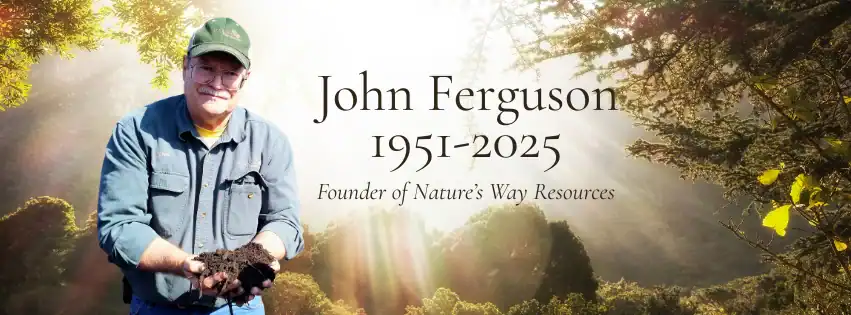
JOHN FERGUSON (1951-2025)
John was a native Houstonian with more than 35 years of business experience. He founded Nature’s Way Resources, a composting company known for producing high-quality compost, mulch, and soil mixes. He held an MS in Physics and Geology and was a licensed Soil Scientist in Texas.
Throughout his career, John received numerous awards in horticulture and environmental work. He represented the composting industry for many years on the Houston-Galveston Area Council for solid waste. His personal garden was featured in several horticultural books and in Better Homes and Gardens. His business was recognized by The Wall Street Journal for the quality and value of its products. He was a member of the Physics Honor Society and several professional organizations, and he co-authored Organic Management for the Professional.
John contributed articles regularly to this newsletter and oversaw its publication. We continue to share his past articles each week alongside The Lazy Gardener column to keep his passion, knowledge, and spirit alive for our readers.
SHELBY CASSANO is the communications and marketing lead for Nature’s Way Resources and the editor of The Lazy Gardener and Friends newsletter. Through her business, Leaf and Ledger, she exclusively partners with NWR to direct all marketing efforts, from campaign strategy and content planning to technical production of the newsletter. Shelby holds a B.S. in Agriculture with a concentration in Horticulture from Stephen F. Austin State University and previously managed the company’s nursery.

NATURE’S WAY RESOURCES
101 Sherbrook Cir.
Conroe, TX 77385
Hours of Operation
Monday – Friday: 8AM to 5PM
Saturday: 8AM to 2PM
Copyright © 2024 Nature’s Way Resources | All rights reserved.